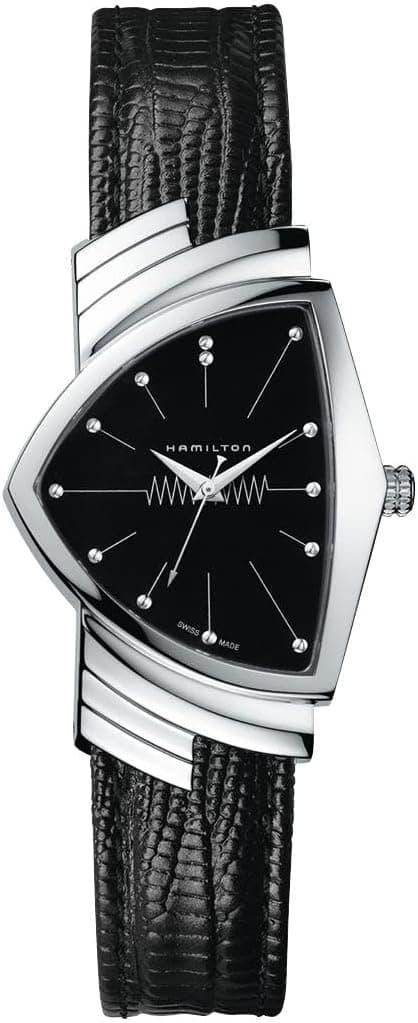
TV / Asymmetric began in watchmaking with the round form in the early 1900s. The shape vocabulary widened over the decades: in 1917 Louis Cartier's Tank made the rectangular form a classic, drawing inspiration from the Renault FT-17 tank chassis. In 1969 the TAG Heuer Monaco brought the square form to the chronograph side. In 1972 Gérald Genta's AP Royal Oak invented the sport-luxury category with an octagonal bezel and integrated bracelet. Tonneau (Franck Muller), cushion (Panerai Radiomir), and oval (Cartier Baignoire) forms carry the vintage character forward.
Practically, round is the most common because it fits the rotational architecture of the mainspring, balance wheel, and escapement train. CNC machining is easier and gasket sealing is simpler. It sits the most comfortably on the wrist. Submariner, Speedmaster, Datejust, Calatrava — all round. Rectangular suits a thin dress watch (the 1917 Cartier Tank, the 1931 Jaeger-LeCoultre Reverso with its reverse-flip design built for polo players). Octagonal and square sit in the statement-piece category: the Royal Oak 15500 at around £32,000, the Bvlgari Octo Finissimo on the ultra-thin integrated side.
Sizing pairs with shape. On a round case the lug-to-lug measurement matters more than the diameter; a 48mm lug-to-lug sits clean on a 17cm wrist, while 52mm+ overhangs. On a rectangular case (the Reverso at 45.6 × 27.4mm) height drives the look more than width; ideal for a slim wrist. Cushion and tonneau forms read smaller at the same millimetre than round because the corners curve. The Apple Watch (rectangular 41/45mm) is the most common non-round daily wear today and has become the smartwatch-world standard.