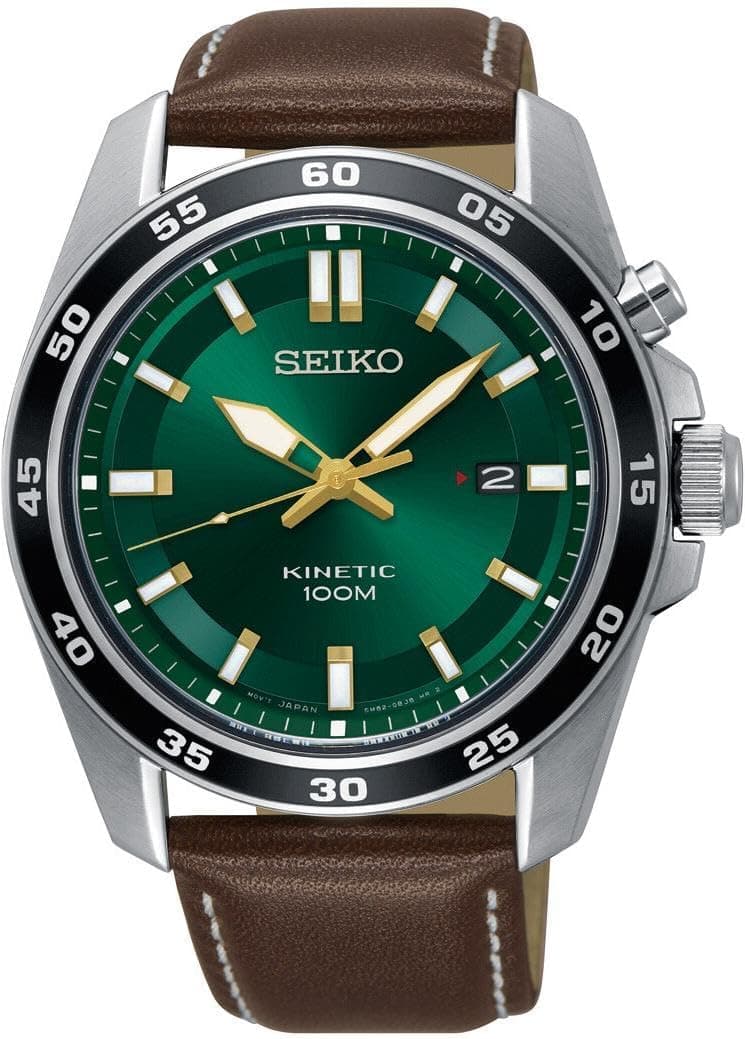
Kinetic is the brand name Seiko gave its auto-quartz technology, a genuine hybrid that sits between mechanical and quartz. Like an automatic, it has an oscillating rotor, but that rotor does not wind a mainspring. Instead it drives a miniature generator that produces electricity, which is held in an energy storage unit and used to run a quartz oscillator. Seiko showed its first Auto-Quartz prototype at the 1986 Basel fair, reached commercial production in 1988, and repositioned the line under the Kinetic name in the late 1990s. The appeal is simple: the watch charges itself on the wrist, keeps running on stored energy when you set it down, and frees you from the years-long battery cycle of a normal quartz piece.
The line splits into a few distinct ideas. The 1998 Kinetic Auto Relay puts the hands to sleep after roughly 72 hours of stillness, conserving about 85 percent of stored power and stretching at-rest running to around four years; calibres like the 5J22 belong to this family. The 2007 Kinetic Direct Drive lets you hand-wind through the crown and watch real-time power generation on the dial, built on the 5D family. On the Prospex side, the 5M85 GMT calibre powers 200-metre divers with a power reserve indicator you check via a pusher at two o'clock, seen in the SUN045 and the PADI SUN065. The top of the range was the Seiko Premier line's 7D56, combining perpetual calendar, Auto-Relay and Direct Drive in one movement. Pricing spans a wide band: Coutura Kinetic perpetual models such as the SNP007 and SNP008 typically run roughly £80 to £320, while a Prospex Kinetic GMT diver lists around £580.
The single most important thing to check when buying is the storage unit. Early Kinetics used capacitors with short reserves; Seiko later moved to lithium-ion cells, which last roughly 8 to 15 years or more with regular use. Lithium cells dislike being left fully depleted for long stretches, so if you are shopping the secondary market, verify the cell's health and confirm the power reserve indicator behaves sensibly. Models with a reserve gauge, the 5M85 and Direct Drive pieces, give you that feedback directly, which makes daily ownership far more relaxed.
Who is Kinetic for? It suits anyone who likes the self-charging feel of an automatic and wants to skip battery changes, but still values quartz accuracy and the fact that a charged Kinetic will not stop the moment you forget it for a day. Seiko has slowed new Kinetic development heavily in favour of Solar and Spring Drive, so much of the action is in existing stock and the used market, which is good news if you want a clean Auto Relay or 5M85 GMT at a fair price. If you are curious about the Swiss take on the same idea, look at ETA's Autoquartz movements, used by Tissot, Longines and Omega between roughly 1998 and 2006.