The Best Chronograph Watches
 Serdar D.Watch Editor
A chronograph is a watch that times events like a stopwatch on top of telling the time. For most people the sensible entry point is a low-maintenance, accurate Seiko quartz chronograph. If you want a dressier daily piece, Citizen fits, and Fossil covers a friendlier entry price.
Key takeaways
- A chronograph is a timing function layered on a watch; a chronometer is a separate accuracy certification, and the two are not the same.
- For most users the sensible choice is a quartz chronograph: low maintenance, accurate, and steady through daily knocks.
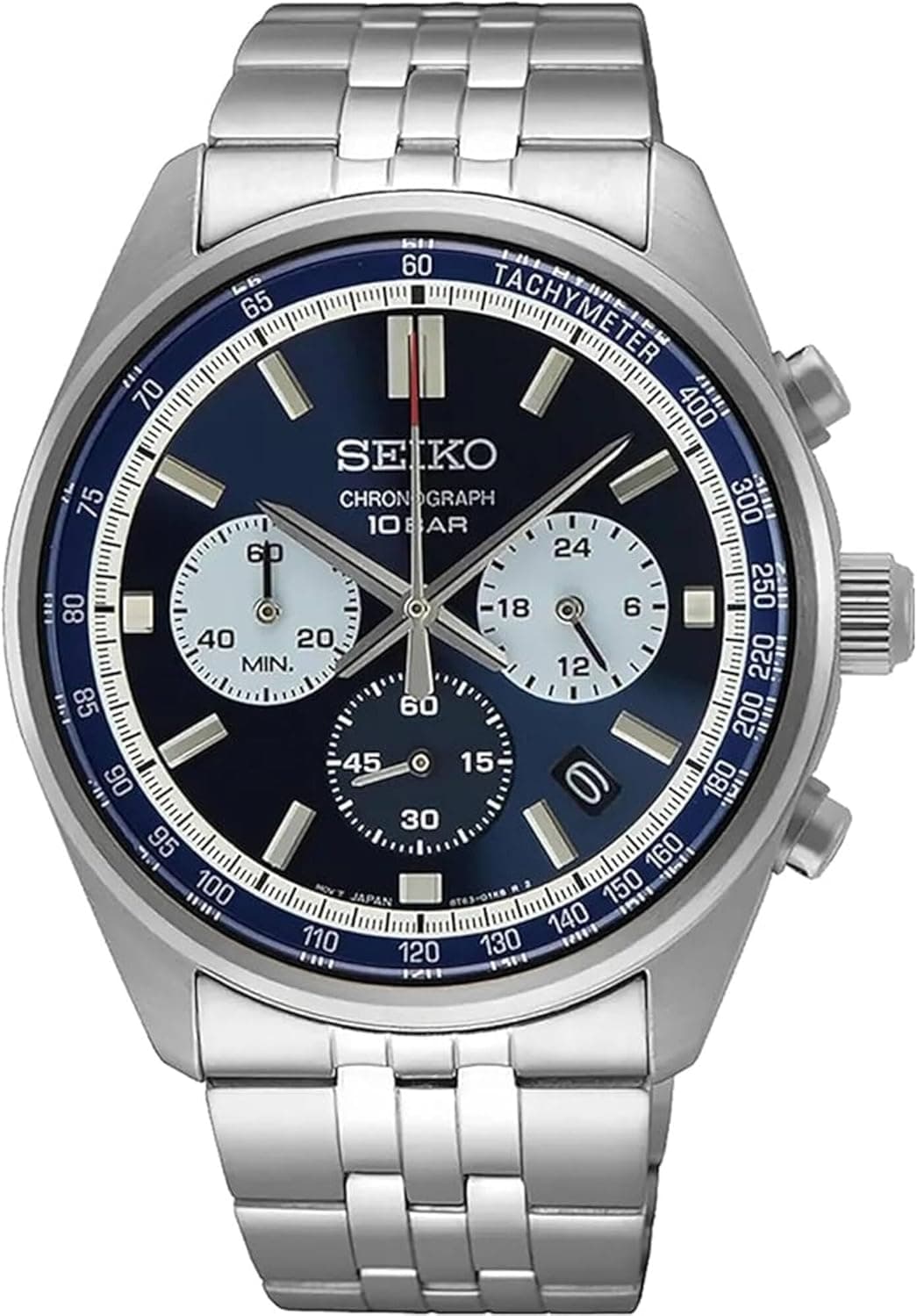
- If you want one watch that bridges sport and smart, my first pick is the Seiko Chronograph, Blue Dial.
- For a classic daily go with the Citizen Classic Corso; for a friendlier entry the Fossil Grant fits.
- A tachymeter looks impressive but you'll rarely use it day to day; its real value is in the design.
What a chronograph is and how to read it
A chronograph is a watch that times events like a stopwatch while still telling the time. Don't let the name fool you: a chronograph is a watch function, while a chronometer is a separate accuracy certification, and people mix the two up constantly. Those little extra dials on the face are sub-dials. In a typical layout one counts elapsed seconds, one counts minutes, one counts hours, while the large centre hand usually sits still and only sweeps once you run the timer.
Using it is simple. Press the top pusher to start, press again to stop, and the bottom pusher resets to zero. One rule worth remembering: don't pull the crown out to set the time while the timer is running, since on mechanical movements that strains the gears.
The best quartz chronograph
For most people the right answer is quartz. The reasons are plain: it asks for next to nothing beyond a battery, a typical quartz movement drifts only around 15 to 30 seconds a month, and the timekeeping stays steady through daily knocks. It is low-maintenance rather than maintenance-free, though: the cell needs replacing eventually, and the seals and gaskets are worth servicing every few years, roughly every three to five. On the build side, a quartz watch won't let you down.
My first pick is the Seiko Chronograph, Blue Dial. It runs a meca-quartz movement, quartz timekeeping paired with a mechanical chronograph module, so you get the steadiness of quartz with a crisper pusher action; the calibre is mature and dependable, the blue dial reads clearly in daylight, and the steel bracelet suits almost any setting. For someone who wants one watch that swings between sport and smart, I see this as a clear starting point.
Seiko Chronograph, Blue Dial product page
A second Seiko option is the Seiko Coutura. If you want a more polished, more presence-forward look and you like a metallic shine, the Coutura layers a touch more jewellery feel on top, and most versions are solar-powered, charging from light so there's no battery to swap.
The best everyday chronograph
If you want a chronograph you can strap on daily and forget, one that suits the office and the weekend, the Citizen Classic Corso is a balanced choice. It runs on Eco-Drive, charging from light rather than a replaceable battery, so it largely looks after itself. The clean dial layout won't age, and the slim case slides under a shirt cuff without fuss. For a quiet, classically minded daily, this is the right watch.
Citizen Classic Corso product page
For a friendlier entry point with a bit more casual character, the Fossil Grant is on the table. With its large sub-dials and a face that reads easily, it's an enjoyable, low-stakes pick for a first chronograph. If you're new to the hobby, look at the Japanese school too; my best Japanese watches guide is a good place to begin.
What a tachymeter is for
That scaled ring around the bezel or the edge of the dial is a tachymeter. It measures average speed over a known distance. Start the chronograph as you pass one kilometre marker, stop it at the next, and the figure the hand points to is your average speed in kilometres per hour. In daily life you'll rarely use it, but it's a chronograph's visual signature, and it's satisfying to know how it works.
Who needs one
Let's be honest: nobody needs a stopwatch on the wrist, the phone does that. A chronograph is as much a design language as a function. If a multi-dial, mechanically minded watch with pushers to play with makes you happy, you're in the right place. If Seiko won you over, I gathered the rest of the line-up in the best Seiko watches piece.
Specifications
| Specification | Value |
|---|---|
| Movement | Quartz, including meca-quartz and solar |
| Counters | Seconds, minutes and hours sub-dials |
| Typical case size | About 40 to 45 mm |
| Bezel scale | Tachymeter on most models |
Pros
- Quartz chronographs need next to no maintenance beyond a battery and drift only around 15 to 30 seconds a month.
- A multi-dial face lets one watch carry you across both sport and smart settings.
- Quartz timekeeping holds its accuracy through daily knocks and temperature swings better than a mechanical movement.
- The wide price range leaves an option for every budget, from first buyer to enthusiast.
Cons
- You don't truly need a stopwatch in daily life; your phone does the same job.
- A multi-counter dial can look busy and cluttered on some wrists.
- Mechanical chronographs cost more and demand more frequent servicing.
- For most users the tachymeter stays a decorative feature that never gets used.
Verdict
For most people starting with a single watch, my pick is the Seiko Chronograph, Blue Dial. With low-maintenance quartz reliability, a clear blue dial, and a steel bracelet that suits any setting, it strikes the best balance between sport and smart. Want a more classic daily? The Citizen Classic Corso. After an easy first chronograph? The Fossil Grant.
Watches we recommend
Frequently asked questions
What is the difference between a chronograph and a chronometer?
A chronograph is the watch's stopwatch function that you start and stop with pushers. A chronometer is a separate certification confirming the watch passes a strict accuracy standard. A watch can be both a chronograph and a certified chronometer, but they are different things.
Should I buy a quartz chronograph or a mechanical one?
For most users quartz makes more sense: maintenance-free, accurate, and with counters that tolerate knocks. You choose a mechanical chronograph for the mechanical feel, the sweeping hand, and the craft. If daily reliability is the priority, go quartz; if feel and craft matter more, look mechanical.
How do you use a tachymeter?
It measures average speed over a known distance. Start the chronograph at one distance marker, stop it at the next, and the figure the hand points to on the tachymeter scale is your average speed per hour. It rarely helps in daily life and is mostly a chronograph's visual signature.

About the author
Serdar D.Watch Editor
View profileSerdar D. is the editor at BraveryWatch. He believes a good watch should be not just expensive but right. He gets deep into the details, then turns them into something that is genuinely a pleasure to read. He gives relaxed, useful advice through the eyes of someone who truly cares about watches.