The Casio F-91W Story

 Serdar D.Watch Editor
The Casio F-91W is a resin digital watch launched in 1989 and still sold in a design Casio calls largely unchanged. It was built down to a price with urethane resin, a module with fewer parts and pins in place of spring bars. A 2017 interview credits designer Ryusuke Moriai, and IEEE Spectrum notes Casio has never published sales figures.
Key takeaways
- Casio dates the F-91W to 1989 and calls it "a record-breaking bestseller," but it has never published sales figures, so the totals quoted online are estimates.
- Casio puts the low price down to construction choices it lists on its own page, including pins in place of standard spring bars.
- Casio's spec sheet lists a 1/100-second stopwatch, daily alarm, LED light, a CR2016 battery of about seven years and accuracy of ±30 seconds a month.
What is the history of the Casio F-91W?
The Casio F-91W is a resin digital watch that Casio launched in 1989 and still sells, with a design its own page calls "largely unchanged" since then. A Casio marketing manager says it was never meant to be a design icon. It was built to be cheap and useful, and Casio's F-91W page explains how the price was kept down. The designer most often named is Ryusuke Moriai, a credit that comes from a 2017 interview rather than from Casio. On November 20, 2026, the Bravery Watch database listed 15 F-91W product pages, covering 11 Casio models, across the US, UK and German stores we track.
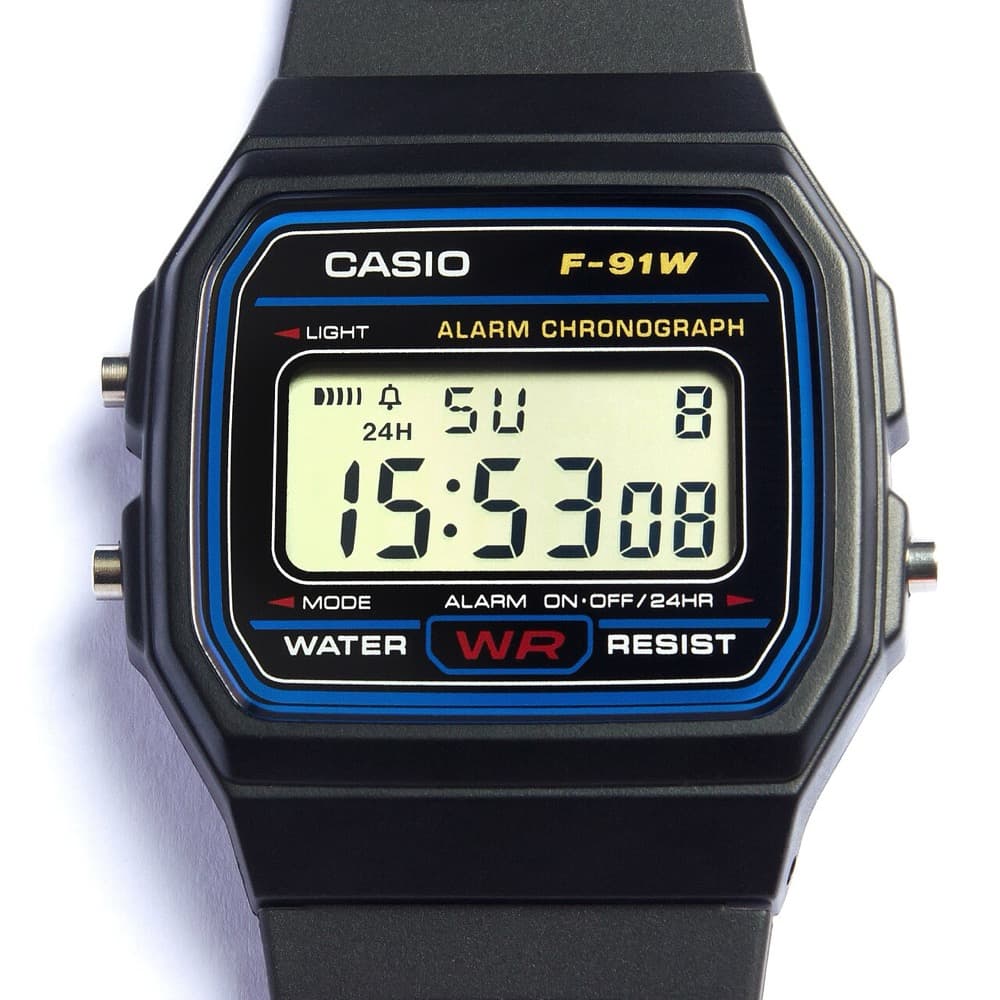 Casio F-91W. Photo: Multicherry, licensed under CC BY-SA 4.0, via Wikimedia Commons; resized.
When was the Casio F-91W released?
Casio dates the F-91W to 1989. Its watch history timeline lists the F-91W among that year's models and says it "takes its place as both the most memorable and a record-breaking bestseller" in the history of Casio watches. The F-91W page on Casio's US site describes "a design unchanged since its 1989 launch." Neither page gives a month, and I have not found Casio giving one anywhere else.
The timeline's entries for that year also show how plain the F-91W was by Casio's standards. Next to it sit a watch with a pressure sensor for predicting the weather and a watch that showed the orbits of the planets. The F-91W did the everyday jobs instead: time and date, a stopwatch, an alarm and a light.
Some of that goes back to Casio's first watch. The Casiotron of 1974 was, in Casio's words, "the world's first digital watch with an automatic calendar," and the F-91W still has a simple version of that calendar. Casio's spec sheet lists it as "Auto-calendar (set at 28 days for February)," so in a leap year the watch goes from February 28 straight to March 1 and stays a day ahead until you correct the date by hand.
Who designed the Casio F-91W?
Casio's history and product pages that I read don't name a designer. The credit that circulates comes from a 2017 aBlogtoWatch article by Ariel Adams, written after an afternoon in Tokyo with Ryusuke Moriai that Casio set up at the writer's request. Adams describes Moriai as the man who "heads Casio timepiece design" and writes that "the first watch Mr. Moriai designed is actually still produced today. He was responsible for the Casio F-91W."
So Moriai is the best-sourced name, and the same article also credits him with the design of G-Shock and many other Casio watches. Still, it is one journalist's account of a conversation, and Casio hasn't put it in its own history.
Why is the Casio F-91W so cheap and so popular?
Casio explains the price itself. "Urethane resin is employed for the case and band, and the module features a reduced number of components," its F-91W page says. It adds that "every element of watch construction was reconsidered, including connecting the band and watch with pins rather than standard spring bars to reduce costs." Casio calls spring bars the standard fitting, so the pins were a deliberate saving. The result, in Casio's words, is "a global hit watch that offers both affordability and long-lasting reliability."
The resin case was not a new idea for Casio by then. Its timeline shows resin cases on sports models from the early 1980s, and its entry for the F-91W describes "a strong, slim, lightweight resin case."
As for the popularity, Casio's own people say they didn't plan it. Warren Halliwell, a senior marketing campaign manager at Casio, told T3 in August 2026: "When the F-91W launched, the focus was creating a practical, affordable digital watch that people would find useful." He added, "The goal wasn't to create a design icon." He put what followed down to the buyers: "What happened over time was that people kept choosing it." T3 also reports Casio saying that its manufacturing methods and quality-control systems have changed over the years while the design and the user experience have not.
When we gave the F-91W a short paragraph in affordable watches that earned their place, we put its staying power down to plainness. Casio's account is more practical than that: it was designed down to a price, and it has stayed affordable. In the best Casio watches it is still our pick for a cheap classic.
What features does the Casio F-91W have?
Casio's spec sheet for the F-91W-1, one of its standard models with a black base tone, is short enough to show in full.
| Feature | What Casio lists |
|---|---|
| Display | Hour, minute, second, pm, date and day; 12/24-hour format |
| Stopwatch | 1/100-second, measuring capacity 59'59.99", elapsed time, split time and 1st-2nd place times |
| Alarm | Daily alarm and hourly time signal |
| Light | LED light |
| Calendar | Auto-calendar (set at 28 days for February) |
| Accuracy | ±30 seconds per month |
| Battery | CR2016, approx. battery life 7 years |
| Case and band | Resin case and bezel, resin band |
| Glass | Resin glass |
| Band size | 145 to 200 mm |
The battery is a CR2016 coin cell. Casio's figure for its life is about seven years, and the operation guide gives the assumption behind it: about 20 seconds of alarm and one second of light a day. The accuracy, ±30 seconds a month at normal temperature, works out to about a second a day, which matches what IEEE Spectrum reported in 2019 as Casio's claim for this quartz watch. How that drift is measured, and why quartz figures are given per month, is in our accuracy entry.
On Casio's pages for the F-91W-1, F-91WG-9Q and F-91WM-3A, the operation guide button points to module 593, and that is the manual to look for.
Is the Casio F-91W waterproof?
Not in the swimming sense. Casio's US page says the F-91W allows "worry-free use while washing up or in sudden rain," and its spec sheets list the water resistance simply as "Water Resistant." Casio Europe's water resistance chart has a row for exactly that class: yes to splashes of water and rain, no to bathing and showering, and no to swimming. Showering starts at the chart's 5 bar class and swimming at 10 bar.
So rain and a splash at the sink are fine, while the shower and the pool are not. How those bar classes work on other brands is in our guide to watch water resistance.
How many Casio F-91W watches have been sold?
Casio doesn't say. Its timeline calls the F-91W "a record-breaking bestseller" without a figure, and IEEE Spectrum wrote in 2019 that "Casio has never provided sales figures for its watches, nor has it revealed its manufacturing output." The 3 million a year that is often repeated is, in IEEE Spectrum's words, "a commonly cited estimate," and the lifetime totals you see online rest on nothing firmer.
Which Casio F-91W models can you buy?
Casio's US page sorts the family into groups. The standard models with a black base tone are the F-91W-1, F-91W-3 and F-91WG-9Q. Then come a "pop design with translucent colors" (F-91WS), a "casual style with colored cases" (F-91WM), models with a band made with bio-based resin (F-91WB) and a PAC-MAN collaboration, the F-91WPC-1A.
Casio's timeline adds relatives that kept the F-91W's functions in another shape, such as the F-105W with an EL backlight. The A159W, by Casio's account, has "the same movement as its peer, the F-91W" with a metal band. The A158 "shares the same specs" as the A159W but comes from a different production location.
Which of these you can find depends a lot on where you live. Our 15 F-91W pages cover 11 Casio models, because some appear more than once under regional reference codes. On November 20, 2026, 5 of those models were in stock in the US with a price checked within the past week, 6 in the UK and 6 in Germany, and 6 had no US listing at all.
The mix differs more than the count: the bio-based F-91WB and the translucent F-91WS were in stock only in Germany. Prices differ between the stores as well, which our look at what Casio watches cost in Europe covers. The F-91WG-9Q was in stock in all three stores that day.
| Watch | Casio's group | US | UK | Germany |
|---|---|---|---|---|
| Casio F-91WG-9Q | Standard, black base tone | In stock, $100 or less | In stock, £100 or less | In stock, €100 or less |
On Casio's spec sheet it has the same 1/100-second stopwatch, daily alarm, LED light, CR2016 battery and resin glass as the F-91W-1, and Casio lists its light color as green. The rest of the family, from the A158W to the G-Shock line, is on our Casio brand page.
How we looked
The story comes from Casio's own pages: the F-91W page on its US site, its watch history timeline, its spec sheets for the F-91W-1, F-91W-3, F-91WG-9Q and F-91WM-3A, the operation guide for module 593 and Casio Europe's water resistance chart. I read those pages in Internet Archive copies made between September 2024 and February 2026, because Casio's sites did not load for us on November 20, 2026; every spec quoted here is Casio's, not a store listing's. The designer credit is from aBlogtoWatch, the sales caveat from IEEE Spectrum and the Halliwell quotes from T3.
The counts come from the Bravery Watch database on November 20, 2026. A product page counts as an F-91W when its model name contains F-91W, so the F-91WM, F-91WG, F-91WS, F-91WB and F-91WC are in and the F-105W, A158W and A159W are not. Pages that carry the same Casio model under different regional codes count as one model. "In stock" means the Amazon US, Amazon UK or Amazon.de listing we link to was available with a price checked within the past seven days. Prices appear only as bands because they change daily; each product page shows the current price for your market.
Sources
- Casio America: Casio F91W, A Classic Casio Digital Watch Forever Popular (F-91W series page, US site; Internet Archive copy of February 9, 2026)
- Casio: Our Heritage, 1970s and 1980s (watch history timeline; Internet Archive copies of June 17, 2025 and April 8, 2025)
- Casio: F-91W-1, F-91W-3 and F-91WG-9Q specifications (international site; Internet Archive copies of June 13, 2025, October 1, 2024 and January 21, 2025)
- Casio America: F91WM-3A specifications (US site; Internet Archive copy of January 18, 2025)
- Casio: Operation guide for module 593 (support site PDF; Internet Archive copy of September 24, 2024)
- Casio Europe: Water resistance (technology page; Internet Archive copy of April 10, 2025)
- Ariel Adams, aBlogtoWatch: An Afternoon In Tokyo With The Man Who Designs Casio G-Shock Watches (April 16, 2017)
- Brian Santo, IEEE Spectrum: The Consumer Electronics Hall of Fame: Casio F-91W Wristwatch (November 7, 2019)
- Matt Kollat, T3: Why Casio refuses to "fix" the F-91W, 35 years after it was initially launched (August 30, 2026)
- Multicherry, Wikimedia Commons: Casio F-91W watch (2023), front closeup (CC BY-SA 4.0)
- Bravery Watch database, product and store data read on November 20, 2026
Watches we recommend
Frequently asked questions
When did the Casio F-91W come out?
Casio dates the F-91W to 1989. Its watch history timeline lists it among that year's models, and its US page describes a design unchanged since the 1989 launch. Neither page gives a month, so a precise launch date is not something Casio itself confirms.
Why is the Casio F-91W so popular?
Casio's page points to the basics: a low price, an easy-to-read display with the day and date, and a stopwatch, alarm and light. Casio's Warren Halliwell told T3 in 2026 that the watch was never meant to be a design icon and that people kept choosing it.
What battery does the Casio F-91W take?
The Casio F-91W takes a CR2016 coin cell. Casio puts the approximate battery life at seven years, assuming about 20 seconds of alarm and one second of light a day. The same CR2016 appears on Casio's spec sheets for the F-91W-1, F-91W-3, F-91WG-9Q and F-91WM-3A.
Can you swim or shower with a Casio F-91W?
No. Casio's spec sheets list the F-91W as Water Resistant, and Casio Europe's chart allows that class splashes of water and rain but not bathing, showering or swimming. Showering starts at the chart's 5 bar class and swimming at 10 bar, so take the watch off before either.
How accurate is the Casio F-91W?
Casio rates the F-91W at plus or minus 30 seconds per month, which works out to about a second a day. IEEE Spectrum reported the same one second a day in 2019 as Casio's claim, and Casio lists the same figure for the F-91W-1, F-91W-3, F-91WG-9Q and F-91WM-3A.
Does the Casio F-91W adjust for leap years?
No. Casio's spec sheet lists the calendar as an auto-calendar set at 28 days for February, so in a leap year the F-91W goes from February 28 straight to March 1. It then runs a day ahead until you correct the date by hand; the other months change over automatically.
How many Casio F-91W watches are sold each year?
Casio does not publish a number. IEEE Spectrum wrote in 2019 that Casio has never provided sales figures, and it called the figure of roughly 3 million F-91Ws a year a commonly cited estimate. Casio's own timeline calls the F-91W a record-breaking bestseller without giving a total.
What is the difference between the Casio F-91W and the A158W?
The A158W keeps the F-91W's functions in a metal version. Casio says its A159W has the same movement as the F-91W but a metal band and a matching metallic case, and that the A158 shares the A159W's specs, made at a different production location. The F-91W keeps its resin case.

About the author
Serdar D.Watch Editor
View profileSerdar D. is the editor at BraveryWatch. He believes a good watch should be not just expensive but right. He gets deep into the details, then turns them into something that is genuinely a pleasure to read. He gives relaxed, useful advice through the eyes of someone who truly cares about watches.