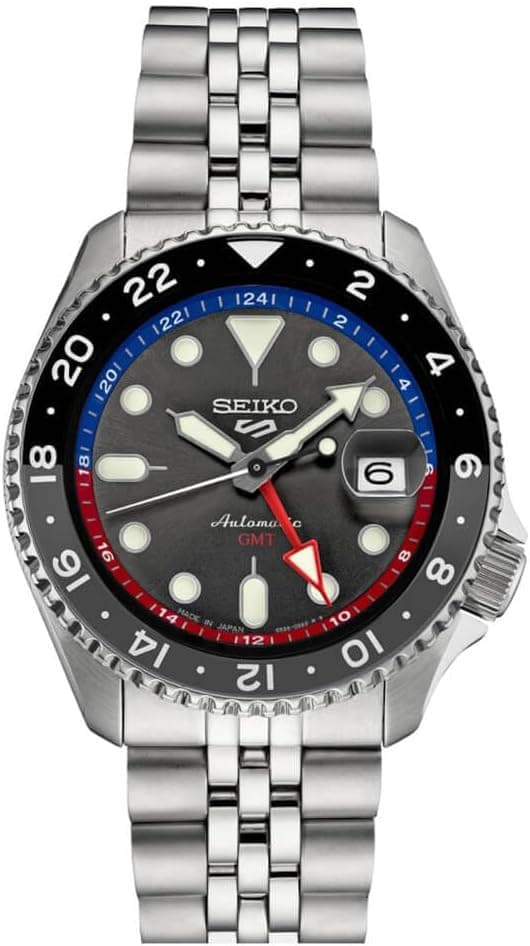
How to Set a GMT Watch
A calm, step-by-step guide to reading the 24-hour GMT hand, telling a caller GMT from a true flyer GMT, and setting home and local time.
 Serdar D.5 min read
Watch guides cover the fundamentals every buyer should know, from movement types and complications to materials, sizing and how to read a spec sheet. Plain-language reference for new and returning collectors.
A calm, step-by-step guide to reading the 24-hour GMT hand, telling a caller GMT from a true flyer GMT, and setting home and local time.
Serdar D.5 min readCharging your watch lume with the right light source is the difference between a glow you can read all night and a faint trace that fades in minutes. Here is how it works and the best method.
Serdar D.5 min readThe full method for changing a watch strap or bracelet at home: the right tool, measuring lug width, standard spring bars versus quick-release, and a step-by-step swap that won't scratch the lugs.
Serdar D.5 min readFog on the inside of the crystal is alarming, but most of the time you can clear it safely at home. I walk through why moisture appears, which steps are safe, what to avoid such as the rice myth, and when a watchmaker and a pressure test are the right call.
Serdar D.5 min readHow to hand-wind an automatic, keep it wound by wearing it, restart it after it stops, and what power reserve really means. I cover the overwinding myth and the fact that not every automatic hand-winds or hacks.
Serdar D.6 min readThe hour, minute, and second hands, reading minutes in fives, the date window, and thinking in 24 hours. A patient, from-zero teaching guide.
Serdar D.5 min readWhat a chronograph's sub-dials show, how the two pushers work, and how to read elapsed time, explained simply. I also clear up the running-seconds versus stopwatch-hand confusion that trips up most beginners.
Serdar D.5 min readA plain-language guide to the tachymeter, telemeter, and pulsometer scales, with a worked example for each and an honest note on which watches actually carry which.
Serdar D.5 min readA calm walk through reading the reference and caliber number on a Seiko caseback, what each part broadly tells you, and how it helps you buy the right spares and spot a fake.
Serdar D.6 min readNever change the date by hand between roughly 9pm and 3am. The date gears are already engaging in those hours, and forcing them wears the teeth. Here is the safe routine, step by step.
Serdar D.6 min readA step-by-step guide to reading elapsed minutes off a dive watch bezel, aligning the zero marker to the minute hand, and why a one-way bezel keeps you safe underwater and useful on land.
Serdar D.5 min readA beater is the watch you wear without worrying about scratches, theft, or loss. Here is what makes one, and why the Casio F-91W, the G-Shock, and the Seiko 5 are the classic answers.
Serdar D.5 min readA watchmaker's plain take on what drives servicing cost, how often a watch needs it, and when you can safely skip it. Cost factors, not invented figures.
Serdar D.5 min readSeiko, Orient, Casio, Citizen, and Fossil for style: a reference guide to the best affordable watch brands, what each is known for, and who each one suits.
Serdar D.5 min readA few seconds of daily drift is normal for an automatic. I walk through magnetism, positions and rest, regulation, and how to tell which one is throwing your watch off.
Serdar D.4 min readFrom daily handling and winding to magnetism, water, service intervals, and storage, a practical owner's guide to keeping a mechanical watch healthy for decades.
Serdar D.5 min readWhat 30m, 100m, 200m, ATM, and bar really mean. A watchmaker walks you through the water resistance ladder, the screw-down crown, and what you can actually do.
Serdar D.5 min readWhether a watch fits your wrist comes down to more than diameter. I walk through how to measure your wrist, which numbers matter, and the quick rules that settle most decisions.
Serdar D.5 min readMovement, case size, water resistance, crystal, strap and build. A plain decision guide to what you are really paying for in a watch, not a product roundup.
Serdar D.5 min readHow to tell a fake watch from a copy: price and seller, weight, dial printing, the seconds-hand sweep, serial numbers, and the box and papers that prove it.
Serdar D.5 min read