How to Read a Chronograph Watch
 Serdar D.Watch Editor
A chronograph is a stopwatch built on top of a normal watch. The large central hand is the stopwatch second hand and normally sits still; the real running seconds tick away in a small sub-dial. The top pusher starts and stops, the bottom one resets. You read elapsed time from the minute and hour sub-dials.
Key takeaways
- A chronograph is a stopwatch built on top of a normal watch, with both functions on one dial.
- The large central hand is the stopwatch second hand and stays still until you start it; the real seconds tick in a small running-seconds sub-dial.
- The top pusher starts and stops, the bottom pusher resets.
- You read elapsed time by adding the hour and minute sub-dials to the seconds where the central hand stops.
- The most common error is thinking the motionless central hand means a fault, when it simply means the stopwatch is not running.
What a chronograph is, briefly
In the simplest terms, a chronograph is a stopwatch built on top of a normal watch. It tells the hour, minute and second as any watch does, and at the press of a button it can time a separate interval. Because both jobs live on one dial, it looks busy at first, but the logic is straightforward once it clicks.
There is one rule that unlocks the whole thing: the large hand sweeping around the dial is not the watch's running second hand. That central hand belongs to the stopwatch, and it stays perfectly still until you start it.
What the sub-dials show
The small circles inside the dial are called sub-dials. On a typical three-register chronograph they break down like this:
- Running seconds: usually the small dial at the left or the bottom. It turns constantly while the watch is running and has nothing to do with the stopwatch. This is how you know the watch is alive.
- Elapsed minutes: counts up the minutes once you start timing. Most models use a 30 or 60-minute scale.
- Elapsed hours: tallies hours for longer measurements. Not every chronograph has one.
Once you notice which small dial is always turning, the rest falls into place. The one ticking constantly is the running seconds; the others, which only fill up when you time something, are the elapsed time.
How the two pushers work
The buttons on either side of the crown are the pushers, and the division of labour is nearly the same on every chronograph:
- Top pusher, start and stop. Press once and the large central hand begins to sweep. Press again and it stops. You can start and stop as many times as you like and add the intervals together.
- Bottom pusher, reset. With the stopwatch stopped, press the lower pusher and all the stopwatch hands snap back to zero. It does not touch the running seconds, which sit on a separate mechanism.
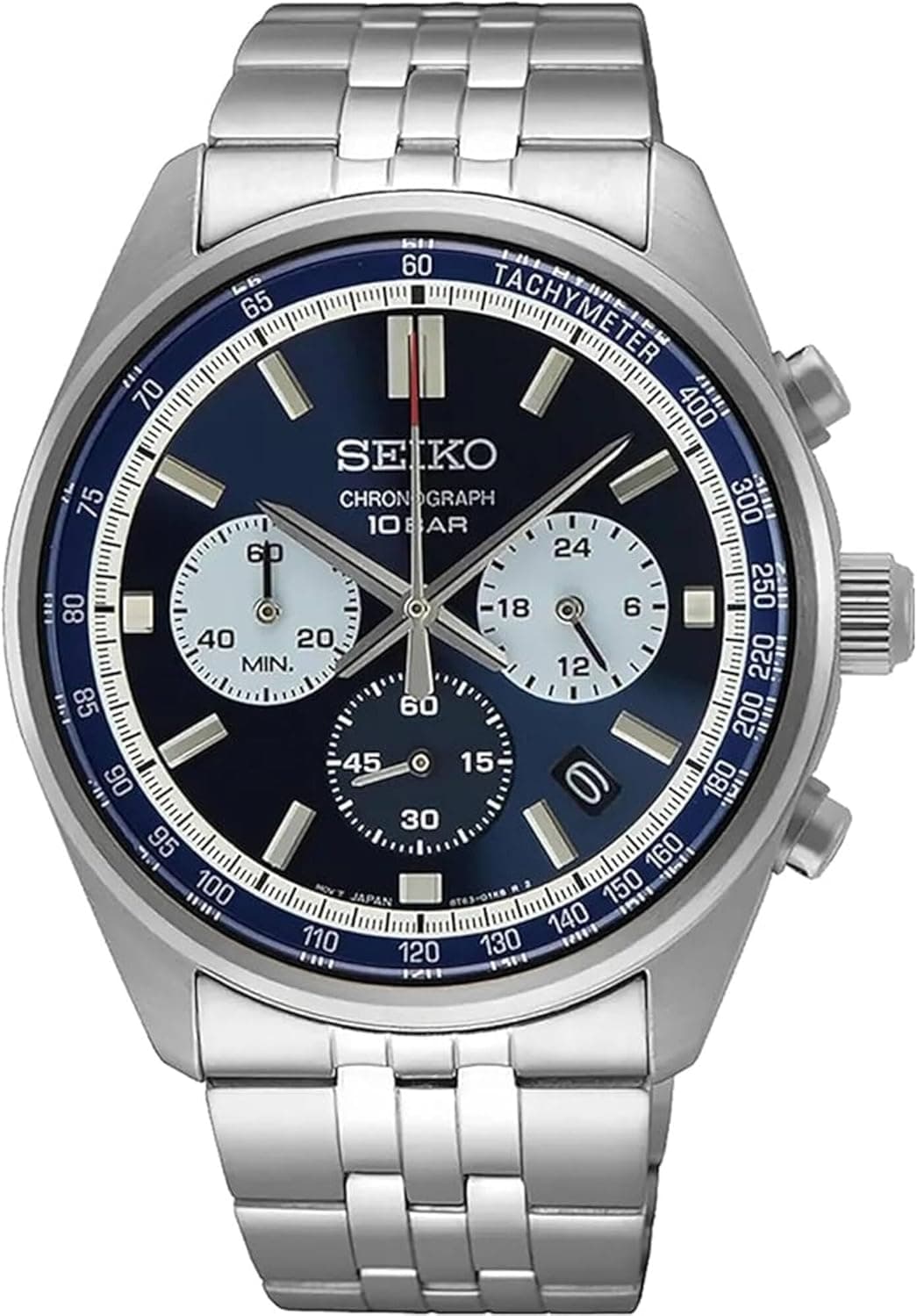
A quartz chronograph delivers all of this with far better accuracy than a mechanical movement and no regular mechanical service, just the occasional battery change; the blue-dial Seiko SSB427P1 is a clean example of the running-seconds versus stopwatch logic, though its third sub-dial is a 24-hour indicator rather than an elapsed-hours counter, and it carries a tachymeter ring around the dial. If you want the same logic on a more classic dial, the Fossil Grant is a good reference point, and for a sportier read the Seiko Coutura fits well.
Reading elapsed time
Say you started the stopwatch and stopped it a while later. You add the time up like this:
- Hours, from the hour sub-dial, if there is one.
- Minutes, from the minute sub-dial.
- Seconds, from where the large central hand has stopped.
If the hour counter reads 0, the minute counter reads 12 and the central hand has stopped at 30, your measured time is 12 minutes and 30 seconds. The logic is exactly like a kitchen timer; the only difference is that the figures are split across one dial.
The most common confusion
Nearly every beginner makes the same mistake: taking the large central hand for the watch's second hand. When you first get the watch and that hand sits still, the watch is not broken. It is still because the stopwatch has not been started. To confirm the watch is actually running, look at the small running-seconds dial that ticks away constantly.
One more detail: some chronographs carry a tachymeter scale. That is the speed-reading ruler around the bezel or dial edge, and it works together with the stopwatch; because it is a topic of its own, I covered it in the guide to chronograph scales.
A short recap and where to go next
Reading a chronograph is easier than it looks: the central hand is the stopwatch, the small turning dial is the real seconds, the top pusher starts and stops, the bottom one resets. Once that logic is in place you can read any chronograph. If you want to compare models, see the best chronograph watches, and for a brand-focused view, the best Seiko watches.
Specifications
| Specification | Value |
|---|---|
| Sub-dial count | Usually two or three registers |
| Pusher roles | Top start and stop, bottom reset |
| Stopwatch seconds | Large central hand |
| Running seconds | Separate small sub-dial |
Pros
- Once the logic clicks, every chronograph reads by the same rule.
- Adding up elapsed time is as simple as a kitchen timer.
- The running-seconds dial confirms the watch is alive at a glance.
- The two pushers share the same labour split on nearly every model.
Cons
- The busy dial can intimidate beginners at first glance.
- The motionless central hand can be mistaken for a fault.
- Sub-dial placement can shift from one brand to another.
- Extra scales such as the tachymeter are a separate thing to learn.
Verdict
Reading a chronograph comes down to grasping a single rule: the central hand is the stopwatch, the small turning dial is the real seconds. For a beginner, the blue-dial quartz Seiko SSB427P1 is a helpful place to learn the two-pusher logic, with far better accuracy than a mechanical movement and only an occasional battery change to think about. Note that its third sub-dial is a 24-hour indicator rather than an elapsed-hours counter, and it carries a tachymeter ring around the dial.
Watches we recommend
Frequently asked questions
Why is the large central hand on my chronograph sitting still?
Because that hand is the stopwatch second hand, not the watch's own seconds, and it stays still until you start it. The watch is not broken; press the top pusher and it begins to sweep. To confirm the watch is running, look at the small running-seconds dial that ticks constantly.
Which pusher does what on a chronograph?
The top pusher starts and stops, the bottom pusher resets. Press the top once to run the stopwatch, press again to stop it; with the stopwatch stopped, press the bottom one and all the stopwatch hands return to zero. This split is the same on nearly every chronograph.
How do I read elapsed time on a chronograph?
You add three values: the hours on the hour sub-dial if there is one, the minutes on the minute sub-dial, and the seconds where the large central hand has stopped. For example, if the minute counter reads 12 and the central hand is at 30, your time is 12 minutes and 30 seconds. The logic is just like a kitchen timer.

About the author
Serdar D.Watch Editor
View profileSerdar D. is the editor at BraveryWatch. He believes a good watch should be not just expensive but right. He gets deep into the details, then turns them into something that is genuinely a pleasure to read. He gives relaxed, useful advice through the eyes of someone who truly cares about watches.