How to Read Chronograph Scales
 Serdar D.Watch Editor
The three classic chronograph scales each measure a different thing. A tachymeter turns the time to cover a known distance into an average speed. A telemeter turns the gap between seeing and hearing an event into a distance. A pulsometer turns a handful of counted heartbeats into beats per minute.
Key takeaways
- There are three classic scales, and most chronographs carry only one, usually a tachymeter.
- A tachymeter turns the time over a known distance into average speed; the distance must be one unit and the time under 60 seconds.
- A telemeter uses the gap between light and sound to give a distance in metres or kilometres; it is a rare scale.
- A pulsometer reads beats per minute directly from a few counted heartbeats and survives on few models.
- The surest way to know a watch's scale is to read the wording around the dial edge.
What a scale is and why it exists
A chronograph measures elapsed time with its counters; a scale takes that elapsed time and converts it into something else. Think of a scale as a printed shortcut for arithmetic. The chronograph counts seconds, and the ring printed around the edge of the dial or on the bezel turns those seconds into a speed, a distance or a pulse rate. There are three classic scales, and most chronographs carry just one of them, usually a tachymeter.
One point matters throughout: every scale reading is taken from the centre chronograph seconds hand, not the small running seconds. You start the timer, stop it, and read the figure the hand points to.
Tachymeter, speed over a known distance
A tachymeter measures average speed and is by far the most common scale. It is a graduated ring that begins at 60 and runs clockwise towards progressively larger numbers, because a shorter elapsed time means a higher speed.
Worked example: Start the chronograph as you pass a mile marker, then stop it at the next mile marker. Say the hand stops at 40 seconds. The tachymeter figure opposite 40 reads 90. That means you are averaging 90 units per hour, so 90 mph. The rule never changes: the distance must be exactly one unit, and the elapsed time must be under 60 seconds. Working in kilometres, the same method gives you 90 km/h.
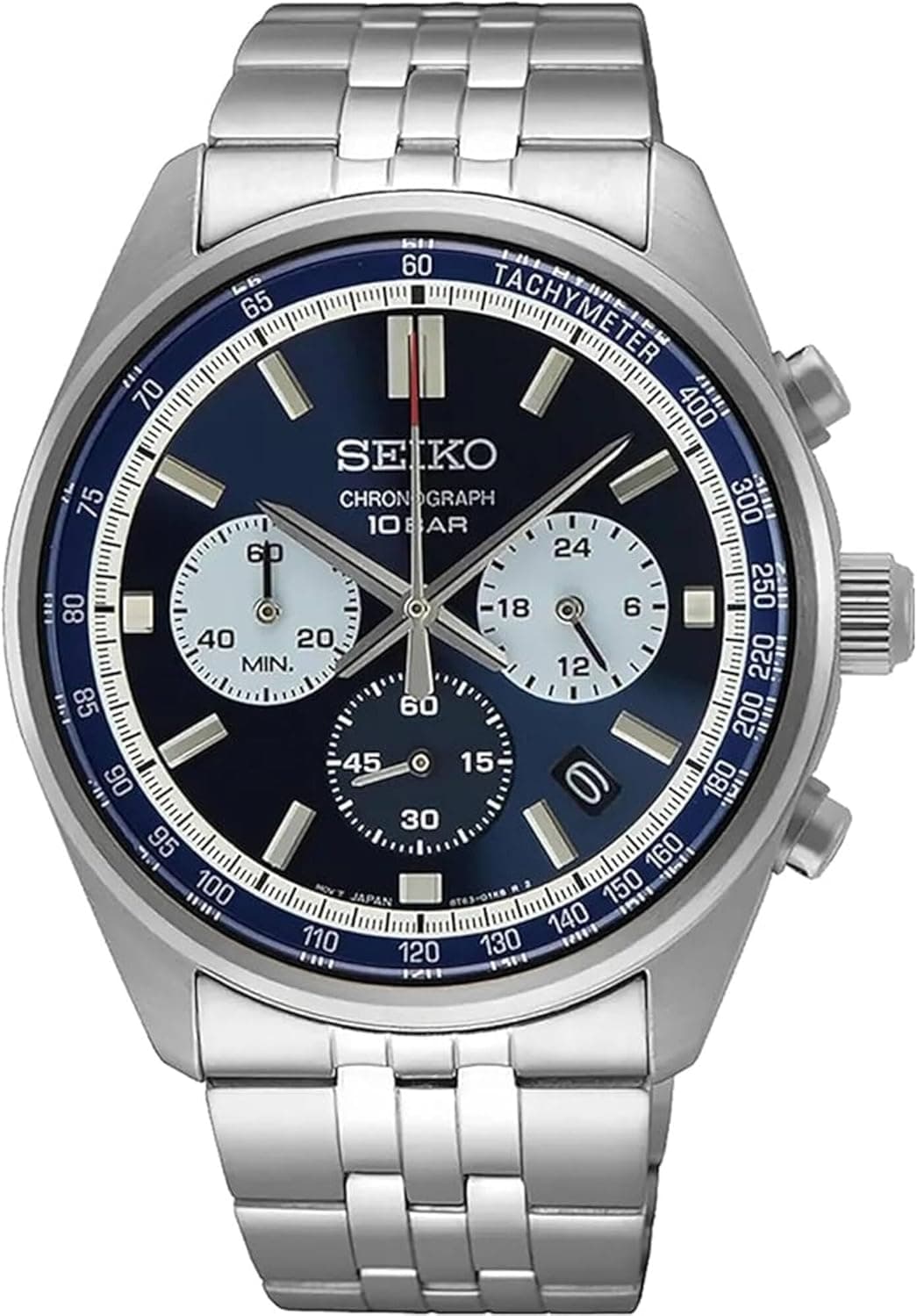
This is the scale most everyday chronographs carry. Of the three watches I recommend, the two Seikos sit in this class. The Seiko Chronograph, Blue Dial is a clean quartz chronograph with a tachymeter ring and a dial that reads clearly in daylight: Seiko Chronograph product page. If you want a more polished, metallic look with a touch more jewellery feel, the Seiko Coutura also carries a tachymeter and is worth a look: Seiko Coutura product page. For a first chronograph with large, easy-to-read sub-dials, the Fossil Grant is a relaxed starting point, though it is a clean Roman-numeral chronograph without a printed scale: Fossil Grant product page.
Telemeter, distance to something you can see
A telemeter works out how far away an event is by timing the delay before you hear it. The logic is simple: you see light instantly, but sound travels at roughly 343 metres per second.
Worked example: Start the chronograph the instant you see lightning, and stop it the moment you hear the thunder. If the hand stops at 5 seconds, the telemeter reads about 1.7 kilometres. Artillery and observation officers once relied on this. Today a telemeter scale is rare, mostly found on military-inspired or classic pilot chronographs. None of the three watches above carry a telemeter, which is why I recommend them for the tachymeter and everyday use, not for this.
Pulsometer, heart rate from a few beats
A pulsometer is a scale designed for doctors. It carries a note such as "graduated for 15 pulsations."
Worked example: Start the chronograph and begin counting a patient's pulse; stop it on the 15th beat. The figure the hand points to is the heart rate in beats per minute directly, with no multiplication needed. The pulsometer is a legacy of physicians' chronographs and survives on only a handful of models today. It is not present on any of the three watches above either.
Which watch actually carries which scale
- The tachymeter is the most common, and the scale you are most likely to find on an everyday chronograph.
- The telemeter and the pulsometer are specialist scales, usually seen on military or medical-inspired pieces.
- The surest way to know which scale a watch has is to read the wording around the dial edge: "tachymetre," "telemeter" or "pulsations."
If you want a refresher on the basic operation, see my guide on how to read a chronograph watch. If you are deciding on a model, the best chronograph watches list is a good starting point, and if it is the Seiko side that drew you in, read my best Seiko watches piece.
Specifications
| Specification | Value |
|---|---|
| Tachymeter | Average speed over a known distance |
| Telemeter | Distance from the light-to-sound delay |
| Pulsometer | Beats per minute from counted pulses |
| Reading hand | Centre chronograph seconds hand |
Pros
- Each scale comes with a concrete, number-by-number worked example.
- An honest, no-hype distinction about which watches really carry which scale.
- The tachymeter, telemeter and pulsometer logic becomes clear without memorisation.
Cons
- The telemeter and pulsometer are rarely useful day to day and are mostly informative.
- Two of the three recommended watches are tachymeter-class and the Fossil Grant carries no printed scale; anyone wanting a telemeter or pulsometer must look elsewhere.
- Reading a scale always relies on the centre chronograph hand, which takes a little habit.
Verdict
The one scale most people will actually use is the tachymeter, and it is the one you will find on an everyday chronograph. If you want a clean, clearly readable chronograph to put this logic into practice, the Seiko Chronograph, Blue Dial is a balanced starting point; the telemeter and pulsometer rarely go beyond curiosity.
Watches we recommend
Frequently asked questions
How do I calculate speed with a tachymeter?
Start the chronograph at the start of a known unit of distance and stop it at the end. The tachymeter figure opposite the seconds where the hand stops is your average speed per hour. The only condition is that the elapsed time stays under 60 seconds.
What is the difference between a telemeter and a pulsometer?
A telemeter measures distance: you start it when you see an event and stop it when you hear it, and the scale shows the distance. A pulsometer measures pulse: you start it counting heartbeats and stop at the stated number of beats, and the scale gives beats per minute. Both are rare scales.
Do the watches you recommend have a telemeter or pulsometer?
No. The Seiko Chronograph and the Seiko Coutura are everyday chronographs with a tachymeter, and the Fossil Grant is a clean Roman-numeral chronograph with no printed scale; none of them carry a telemeter or pulsometer. A telemeter usually appears on military-inspired or pilot chronographs, and a pulsometer on older physicians' chronographs.

About the author
Serdar D.Watch Editor
View profileSerdar D. is the editor at BraveryWatch. He believes a good watch should be not just expensive but right. He gets deep into the details, then turns them into something that is genuinely a pleasure to read. He gives relaxed, useful advice through the eyes of someone who truly cares about watches.