What Is a GMT Watch
 Serdar D.Watch Editor
A GMT watch shows a second time zone with an extra hand that turns once every 24 hours against a 24-hour scale on the bezel or dial, so you see whether it is day or night there. A true GMT lets you set the hour hand alone in one-hour steps; an office GMT lets you set the 24-hour hand alone.
Key takeaways
- Read the number the 24-hour hand points to, not its angle: at 15 it is 3 p.m. in the second zone. With a rotating 24-hour bezel you can follow a third zone, as Seiko's 4R34 instructions note.
- Makers describe three setups: Seiko's 4R34 sets the 24-hour hand on its own, Miyota's 9075 the hour hand, and on Orient's F6P2 neither, so the second zone comes from the bezel.
- GMT is rare by name: 12 of the 2,200 watches in stock in the US in our November 18, 2026 data carried it, 3 of them in the $100 to $150 band and only one above $1,000.
What is a GMT watch?
A GMT watch shows a second time zone with an extra hand that goes around the dial once every 24 hours instead of twice. You read the tip of that hand against a 24-hour scale on the bezel or the dial, so it tells you the hour somewhere else and whether it is day or night there, while the normal hands keep your local time.
The name comes from Greenwich Mean Time, the time on the meridian through Greenwich in London. Royal Museums Greenwich calls Coordinated Universal Time (UTC) "the modern equivalent of Greenwich Mean Time (GMT)" and adds that the world's time zones are "usually a number of whole hours different from UTC." That second line is why the idea works on a wrist. If the places you care about sit whole hours apart, one hand on a 24-hour scale can follow them, and the minute hand serves every zone at once.
What the word GMT on a dial doesn't tell you is how the watch handles that second zone. I read the instructions for three movements and found three different answers, and the answer decides how much crown turning a trip costs you. Bravery Watch keeps specifications and prices for the US, UK and German markets side by side, and every example below was in stock in the US on November 18, 2026. The short definition sits in our GMT glossary entry, and if you only need the crown positions, how to set a GMT watch walks through them.
How does a GMT watch work?
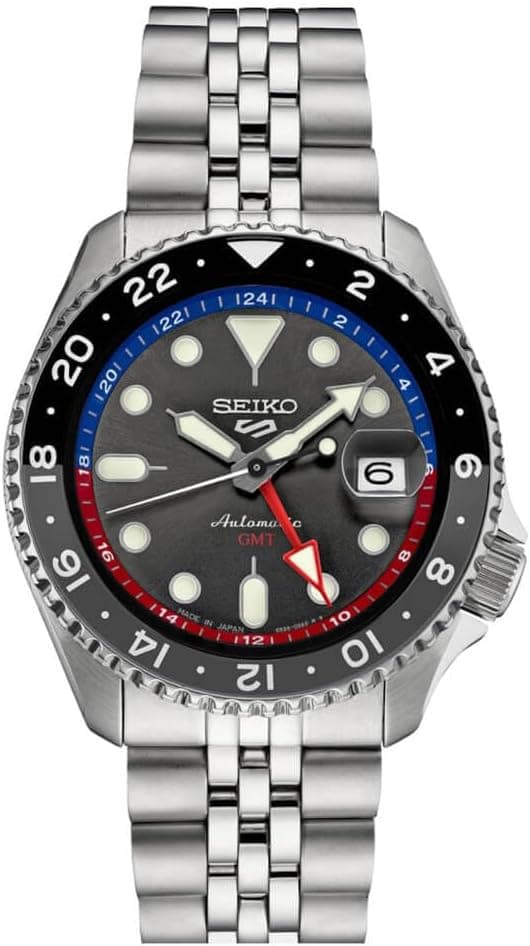
The 24-hour hand turns at half the speed of the hour hand. Seiko's instructions for its automatic caliber 4R34, the movement in the Seiko 5 Sports GMT, give it two jobs. Left in step with your local time, it shows "whether the displayed time is AM or PM." Set to another place, it becomes what Seiko calls a dual time indicator. Seiko's own example puts the hour hand and the date on Japan and the 24-hour hand on Honolulu, so one dial shows both places, and in that example their dates are a day apart.
So you read the number the hand points to, not its angle. If the 24-hour hand points at 15, it is 3 p.m. in the other zone; if it points at 3, it is 3 a.m. there. That takes a moment to get used to, because on a 24-hour scale the 15 sits where a 12-hour dial puts half past seven.
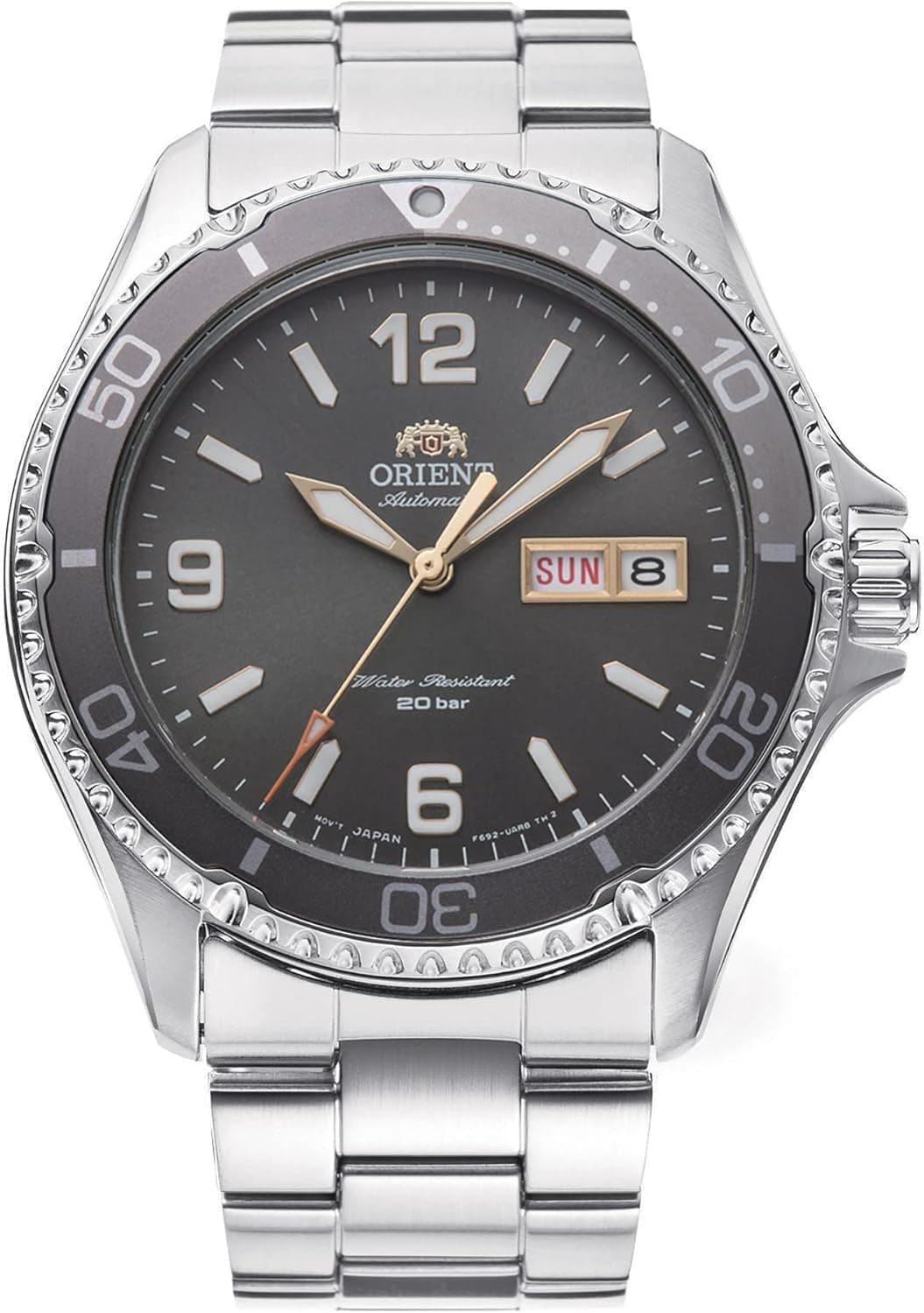
A rotating 24-hour bezel adds a third zone. For its models with such a bezel, Seiko puts it in one line: "Three different time zones can be read by turning the rotating bezel." That means local time on the hour hand, a second zone on the 24-hour hand, and a third once you turn the bezel by the time difference. Orient's user guide for its F6P2 calibers (the Mako GMT carries the F6P22) spells out the arithmetic for a bezel that only turns one way. Take the time difference of the other place, subtract that of the zone the 24-hour hand shows (on the Orient, your current place), add 24 if the result is negative, and turn the bezel counterclockwise by that many hours.
True GMT vs office GMT: what is the difference?
The difference is which hand you can move on its own. Here is how three makers describe their movements:
| Movement (watch) | What moves on its own | Second zone read on | Maker's wording |
|---|---|---|---|
| Seiko 4R34 (Seiko 5 Sports GMT) | 24-hour hand | 24-hour hand | "Turn the crown clockwise to adjust the 24-hour hand." |
| Miyota 9075 (Bulova Oceanographer GMT) | hour hand, one hour per step | 24-hour hand | "Individual hour hand adjustment" |
| Orient F6P2 (Orient Mako GMT) | nothing; the 24-hour hand follows the hour hand | rotating bezel | "cannot be adjusted independently" |
On the Seiko 4R34 you set the hour and minute hands at the second crown click, then pull to the first click and turn the 24-hour hand alone; Seiko notes that "the seconds hand continues moving." That is the setup our glossary calls a caller or office GMT (see caller vs true GMT). You keep local time where it is and point the 24-hour hand at the place you follow, say the office you call every afternoon.
Miyota sells its 9075 as a "Mechanical movement equipped with True GMT function." Its manual has you set the hour and minute hands "to home time" at the outer crown position, then use the middle position "to set the hour hand and date to local time," one hour per step. Bulova lists the 9075 for its Oceanographer GMT 98B407 and describes "an independently adjusted hour hand that allows you to quickly set the local time." This is the true or flyer GMT. When you land, you move only the hour hand, the 24-hour hand keeps home time, and the date follows the hour hand, so it stays right for where you are.
Orient's F6P2 is the third case, and it is easy to miss because the watch still has a 24-hour hand and GMT in its name. The guide is plain about it: "The 24-hour hand is synchronized with the hour and minute hands, and this cannot be adjusted independently." The second zone comes only from the rotating bezel. Orient's product page for the Mako GMT RA-BC0005L puts it the same way: "dual timezone functionality thanks to its rotating bezel."
Which one suits you depends on how you move. If you fly and change local time often, the hour-hand jump of a true GMT saves the most fiddling. If you stay in one place and follow one other, setting the 24-hour hand alone is all you need. With a synchronized hand like Orient's, you get a.m. and p.m. for local time plus a bezel you turn whenever you want the other zone, which works fine for an occasional call abroad. If a listing doesn't say which kind you're buying, the maker's manual does: check which crown position moves which hand.
Is a GMT watch the same as a world timer?
No. A world timer shows every zone at once, where a GMT adds one. Junghans describes its Meister Worldtimer 27/3010.01 this way: "All 24 time zones are available to the wearer at a glance by correlating the hour disc with the cities represented on the dial." Once the hands show local time, setting the zones takes one step. In crown position B, the J820.5 manual says, each full clockwise turn of the crown moves one time zone; in Berlin at 3 p.m. you turn until 15 sits next to Berlin, and "the current hour of all other 23 time zones is now indicated." Junghans adds that you only repeat this when the clocks change or when you travel and want a different local time.
Digital watches do the same in software. Casio's page for the AE-1200WHUB-8AV, a digital watch that lists world time for "31 time zones (48 cities + coordinated universal time)," also names a Multi Time view of 4 cities and "Home city/World time city swapping." That last function is the one a traveler wants, because the other city becomes the main display. Listings call this dual time or world time rather than GMT.
Are GMT watches expensive?
Not as a rule. On November 18, 2026, our database had 2,200 watches in stock in the US with a price no older than seven days, and only 12 of them carried GMT in their listing title or name. Another 27 said world time or dual time, and 20 of those were Casio. Among the 12 GMT watches, 3 sat in the $100 to $150 band, and all three were versions of one Stuhrling model; only one of the 12 sat above $1,000. Our GMT and world time page lists every watch we file under these functions.
These are the examples from this page, with values from the makers:
| Watch | How it shows the second zone | Movement | Water resistance | US price band |
|---|---|---|---|---|
| Seiko 5 Sports SKX GMT SSK019 | 24-hour hand set on its own, 24-hour bezel | automatic, caliber 4R34 | 100 m | $300 to $400 |
| Orient Mako GMT RA-BC0005L | rotating 24-hour bezel; 24-hour hand follows local time | automatic, F6P22 | 200 m | $300 to $400 |
| Bulova Oceanographer GMT 98B407 | hour hand set on its own, 24-hour scale on the dial | automatic, caliber 9075 | 200 m | $750 to $1,000 |
| Casio AE-1200WHUB-8AV | digital world time, 31 time zones | quartz | 100 m | $100 or less |
| Junghans Meister Worldtimer 27/3010.01 | world timer, 24 cities around a 24-hour disc | automatic, J820.5 | 50 m (5 bar) | over $2,000 |
Seiko gives the SSK019 a 42.5 mm case and Hardlex crystal, with a large GMT hand in red accents over its bi-color 24-hour bezel, while Orient fits the Mako GMT with sapphire and the counterclockwise bezel described above. The Bulova pairs its 41 mm case with a one-way timing bezel (the kind explained in how to use a dive watch bezel), so its 24-hour scale is printed on the dial instead.
How we looked: The counts come from the Bravery Watch database on November 18, 2026 (19:19 UTC). A watch counted for the US when its Amazon US listing was in stock, valid and priced in dollars, with the price fetched in the last seven days: 2,200 watches. GMT, world time and dual time are counted by name (the listing title, product name or our display name), not by checking each movement, so a GMT that doesn't say so in its name is missed. Price bands are ranges, not prices, and prices change daily. Every specification above comes from the maker's own page or manual, read on November 19, 2026; Seiko's US page and Bulova's US page were read through archived copies, and Bulova's live figures from its UK and Ireland site.
Sources
- Royal Museums Greenwich: Which time is it? (checked November 19, 2026)
- Seiko Watch Corporation: Instructions for caliber 4R34, How to set the time, 24-hour hand and date (checked November 19, 2026)
- Seiko Watch Corporation: Instructions for caliber 4R34, How to use the rotating bezel with 24-hour scale (checked November 19, 2026)
- Seiko Corporation of America: Seiko 5 Sports SKX GMT U.S. Special Creation SSK019, product page (archived September 9, 2026; checked November 19, 2026)
- Miyota (Citizen Watch Co.): Caliber 9075, movement page (checked November 19, 2026)
- Miyota (Citizen Watch Co.): Cal. 9075 instruction manual, Adjusting date and time, Adjusting local time (checked November 19, 2026)
- Bulova: Oceanographer GMT 98B407, product pages (UK and Ireland site, checked November 19, 2026; US page archived January 20, 2025)
- Orient: User's Guide for caliber F6P2 (BC), How to Set the Time and Calendar and How to Use the 24-hour Hand (checked November 19, 2026)
- Orient Watches UK: Orient Mako GMT Limited Edition RA-BC0005L, product page (checked November 19, 2026)
- Uhrenfabrik Junghans: Meister Worldtimer 27/3010.01, product page (checked November 19, 2026)
- Uhrenfabrik Junghans: Manual for the self-winding movement J820.5, Adjusting the time zones (checked November 19, 2026)
- Casio America: AE-1200WHUB-8AV, product page (archived November 14, 2024; checked November 19, 2026)
Watches we recommend
Frequently asked questions
What is a GMT watch?
A GMT watch has an extra hand that circles the dial once every 24 hours and points to a 24-hour scale on the bezel or the dial. That hand shows a second time zone, including whether it is day or night there, while the normal hour and minute hands keep your local time.
How does a GMT watch work?
A GMT watch turns its 24-hour hand at half the speed of the hour hand. Kept in step with local time, it tells a.m. from p.m.; set to another place, it shows that zone's hour on the 24-hour scale. Seiko's 4R34 instructions add that a rotating 24-hour bezel lets you read a third zone.
What is the difference between a true GMT and an office GMT?
On a true or flyer GMT, the crown moves the local hour hand on its own in one-hour steps, as on Miyota's caliber 9075. On an office or caller GMT, such as Seiko's caliber 4R34, the crown moves the 24-hour hand on its own while the hour and minute hands keep local time.
What does GMT stand for on a watch?
GMT stands for Greenwich Mean Time, the time on the meridian through Greenwich in London. Royal Museums Greenwich calls Coordinated Universal Time, or UTC, its modern equivalent. On a watch dial the letters have come to mean a second time zone, shown by a hand that turns once a day.
Can you set the GMT hand separately on every GMT watch?
No. On Orient's F6P2 calibers, the family of the F6P22 in the Orient Mako GMT, the 24-hour hand is synchronized with the hour and minute hands and cannot be adjusted on its own. That watch shows a second time zone only when you turn its rotating 24-hour bezel by the time difference.
Is a GMT watch the same as a world timer?
No. A GMT watch adds one time zone, while a world timer shows all of them at once. The Junghans Meister Worldtimer 27/3010.01 reads 24 time zones from an hour disc and a ring of cities, and Casio's digital AE-1200WHUB-8AV covers 31 time zones in its world time mode.
How do I know which type of GMT watch I have?
Look up the crown positions in the maker's manual. If one position moves the 24-hour hand alone, it is an office or caller GMT. If one moves the hour hand alone in one-hour steps, it is a true GMT. If neither does, the second time zone comes from the rotating bezel.
Can you get a GMT watch for under $150?
Yes. On November 18, 2026, 12 of the 2,200 watches in stock in the US in the Bravery Watch database carried GMT in their name, and 3 of them sat in the $100 to $150 price band. Only one of the 12 sat above $1,000, so a second time zone does not have to be expensive.

About the author
Serdar D.Watch Editor
View profileSerdar D. is the editor at BraveryWatch. He believes a good watch should be not just expensive but right. He gets deep into the details, then turns them into something that is genuinely a pleasure to read. He gives relaxed, useful advice through the eyes of someone who truly cares about watches.