How Tight Should a Watch Be and Where Should It Sit?
 Serdar D.Watch Editor
Wear a watch just above the wrist bone, toward your elbow, snug enough that it stays in place but with room to slip about one finger under the strap. Timex's stricter test is a fingertip under the buckle. On smartwatches, Apple, Garmin, Fitbit and Casio suggest a tighter band for workouts and a looser one afterward.
Key takeaways
- The finger test differs by maker. Timex asks for a fingertip between buckle and wrist, Jowissa and Casio a whole finger under the strap, and Google just a pinky under the woven and metal bands of its Fitbit Air.
- A watch belongs above the wrist bone, never on it. Jowissa says just above it and Apple above it toward the elbow, while Fitbit, Casio and Garmin put a smartwatch one or two finger widths above the bone.
- For heart-rate readings, Apple, Garmin, Fitbit and Casio all suggest a tighter band during workouts or measurements than for the rest of the day, though Garmin warns that wearing it too tight can hurt heart-rate accuracy as well.
How tight should a watch be?
A watch should be snug enough that it doesn't slide around your wrist, yet loose enough that you can slip about one finger under the strap. It sits just above the wrist bone, toward your elbow. Apple calls the right fit for its watch "snug but comfortable," and the Swiss watchmaker Jowissa says a finger should slip under the strap or bracelet "without forcing it." Timex is stricter and asks only for a fingertip under the buckle, so the makers' range runs from a fingertip to a full finger.
For an ordinary watch, that is most of the answer. Smartwatches are a little different. Apple, Garmin, Fitbit and Casio all ask for a tighter band while you exercise, and each puts the watch in a slightly different spot on the wrist. I'd rather give you their own words than average them into one rule, and for each kind of strap I picked one example watch from the Bravery Watch database.
How loose should a watch be?
It should be loose enough for at least a fingertip, but never so loose that the watch slides around. Timex calls its test the one-finger rule, though it only asks for the tip of your index or pinky finger "between the buckle and your wrist comfortably without being able to move it around too much." If the fingertip won't go under the buckle, loosen the strap a notch. If your finger fits beneath the band and you can "easily move it side to side more than an inch," Timex says the fit might be too loose and need tightening.
Jowissa and Casio leave more room. Jowissa says a watch should feel "secure and comfortable, without pinching or sliding freely around your wrist," with room to slip a whole finger under the strap, and Casio asks for the same finger in everyday wear of its GSW-H1000 smartwatch. For the woven and metal bands of its Fitbit Air tracker, Google lands in between, with just enough room to slide your pinky under the band. With an Apple Watch, the test is a shake instead. Shake your wrist, turn your palm up, and if the back of the watch loses contact with your skin, tighten the band, as Apple advises.
So is it okay for a watch to be a little loose? Yes, and Timex is relaxed about it. The fit, it says, "doesn't affect the ability for your timepiece to tell time" and is "mostly dictated by personal preference." The limits are practical ones. A watch that slides around all day can snag on clothes and twist until you can't read it, and Timex adds that one loose enough to catch on things can stretch or break the strap.
How far up the wrist should you wear a watch?
It goes above the wrist bone, never on top of it, and how far above depends on whose manual you read.
| Maker | How snug | Where it sits |
|---|---|---|
| Timex | A fingertip fits between buckle and wrist, with little room to move | Not stated in its fit guide |
| Jowissa | A finger slips under the strap without forcing | Just above the wrist bone, toward the forearm |
| Apple | Snug but comfortable | Above the wrist bone, toward your elbow, not your hand |
| Garmin | Snug but comfortable; in daily wear the band can move back and forth | Two finger widths above the wrist bone |
| Fitbit (Google) | Snug but not constricting during exercise | A finger's width above the wrist bone when not exercising, a bit higher during exercise |
| Casio | Tight enough to keep the watch from sliding while measuring; loose enough for a finger otherwise | At least one finger width from the bone on the side of the wrist |
The bone in question is the knob that sticks out on the side of your wrist. Casio's GSW-H1000 guide names it the ulna and says to keep adding fingers until the watch no longer covers it, and Apple tells you to move the watch above the bone if it sits on top of it.
For an ordinary watch, just above the bone is enough, and Jowissa says that keeps your hand free to move. Apple wants its watch above the bone too, so the sensors keep contact with your skin. Garmin, Fitbit and Casio go higher still, and Google explains why for Fitbit, saying that bike riding or weightlifting bends the wrist often and could interfere with the heart-rate signal if the watch sits lower. So for a smartwatch, my advice is one or two finger widths above the bone, whichever figure its own maker gives.
How should a watch strap or bracelet fit?
Timex says its one-finger rule "applies to metal bracelets and leather straps alike." What changes from one strap to the next is how finely you can set it.
A leather strap moves one hole at a time, and so do resin and rubber or silicone straps. Leather also changes as you wear it. Timex says it "will soften over time and mold to your skin," so you may need to go a hole tighter later, but don't overdo it, because Timex also warns that overtightening stretches leather and puts unnecessary pressure on a bracelet's links.
A NATO strap is a single length of woven nylon threaded under the case and tightened at the buckle, and the slip-thru fabric strap on the Timex Weekender works the same way. If no hole on a strap gets you between a fingertip and a finger of room, the strap is the wrong length. The watch band size chart shows which length to look for, and our guide to changing a watch strap covers the swap, spring bars included.
Bracelets work differently. You size a bracelet by removing links and fine-tune it with the micro-adjustment holes many clasps have. Rolex goes further, with a Glidelock system that changes the length in small steps at the clasp and an Easylink extension link that folds out for a little extra length without tools. Our metal bracelet page goes through sizing and those clasps. An expansion band simply stretches over your hand, and you size it by its removable links, as on the Timex Easy Reader. A mesh bracelet has no links to remove at all; its clasp slides along the mesh instead, as on Bulova's Goddess of Time.
All eight example watches below were in stock in the US and the UK on November 18, 2026, with a price updated within the past week.
| Strap | Example watch | What the maker lists | US price range | UK price range |
|---|---|---|---|---|
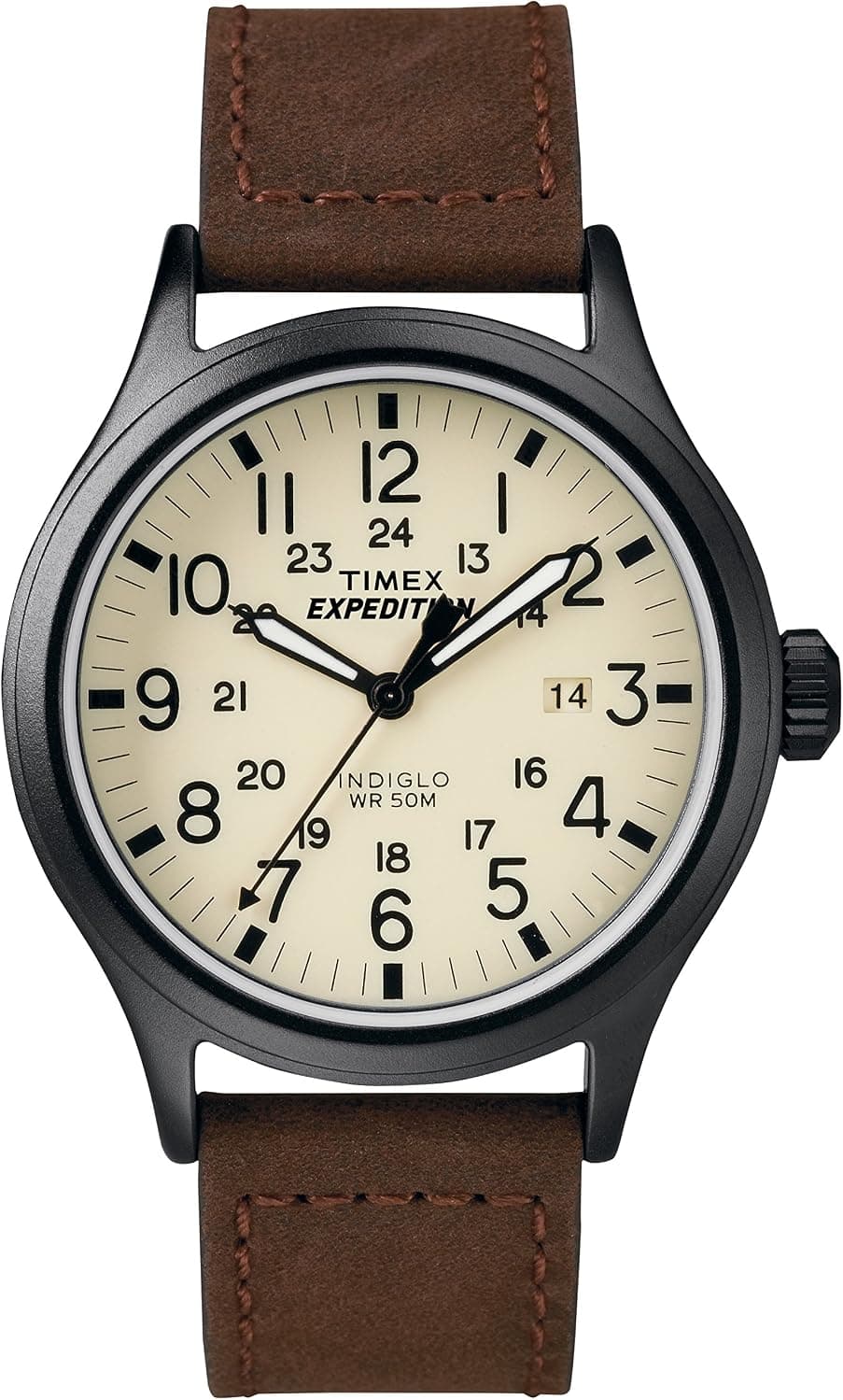
| Leather | Timex Expedition Scout T49963 | Leather strap with buckle | $100 or less | £100 or less |
| Fabric | Timex Weekender T2N651 | Slip-thru fabric strap with buckle | $100 or less | £100 or less |
| Silicone | Bulova Marine Star 98A226 | Silicone strap with buckle | $300 to $400 | £300 to £400 |
| Resin | Timex IRONMAN Classic 30 T5E901 | Resin strap with buckle | $100 or less | £100 or less |
| Steel bracelet | Bulova Surveyor 96B429 | 3-link stainless steel bracelet, deployant clasp with push buttons | $250 to $300 | £150 to £200 |
| Mesh bracelet | Bulova Goddess of Time 96L343 | Mesh bracelet with a sliding clasp | $250 to $300 | £150 to £200 |
| Expansion band | Timex Easy Reader T20461 | Stainless steel expansion band with removable links, no buckle | $100 or less | £100 or less |
| Silicone (smartwatch) | Garmin Forerunner 165 | 20 mm quick-release silicone band; fits wrists of 126 to 203 mm (about 5 to 8 inches) | $150 to $200 | £100 to £150 |
How tight should a smartwatch be for accurate heart rate?
Snug while you train, a little looser the rest of the day. Apple, Garmin, Fitbit and Casio all agree on this, and all four tie it to the heart-rate sensor on the back of the watch.
Apple only goes as far as "You might want to tighten your Apple Watch band for workouts, then loosen it a bit when you're finished." Garmin is firmer. Its Forerunner 165 manual says the watch "should be snug but comfortable" and, for more accurate heart-rate readings, "should not shift while running or exercising," while its wear and care page wants the band tightened for workouts and loosened once you've finished.
Google wants Fitbit owners to wear the device a bit tighter and higher during exercise, "snug but not constricting, as a tight band restricts blood flow and can potentially affect the heart rate signal." Casio's guide for its heart-rate G-SHOCK watches with module 3554 asks for a band tight enough to keep the watch from sliding, loosened after the measurement until a finger fits, and says that if you can see green light coming from behind the watch, it isn't fastened correctly.
Tighter isn't automatically better, though. Garmin warns that "wearing your device too tight can negatively affect optical heart rate accuracy." On a strap with holes, all of this comes down to two of them, a tighter one for the run or the gym and your usual one for the rest of the day.
Is it normal for a watch to leave marks?
No, a mark means the strap is too tight. Garmin is blunt about it. "You should never see any form of impression left on the skin from the band or any part of the device." In Timex's gentler words, you don't want a watch so tight that it leaves marks in your skin or cuts off blood flow. Apple adds that an overly tight band can cause skin irritation, and Casio says a band tightened for heart-rate measurements can make it hard for air to pass under it and cause you to sweat, which can lead to skin irritation. To give your skin some time to rest, Casio advises taking the watch off regularly.
Too loose shows up differently, and Apple says a band that's too loose can cause rubbing. If your skin turns red, swells or itches, Apple suggests you consult a physician before putting the watch back on.
How should a watch fit?
A watch fits when the strap leaves a fingertip to a finger of room and the case sits just above the wrist bone. That still assumes the case suits your wrist, which is a question of size rather than tightness. Our guide to sizing a watch explains why lug-to-lug matters more than case diameter, and the watch size calculator turns your wrist measurement into a range of case sizes. If a watch keeps catching on your shirt cuff, our guide to watch case thickness covers that.
How we looked
I read every fit rule on the makers' own pages on November 18, 2026, and everything in quotation marks is their wording. The heart-rate and skin statements are the makers' claims about their own devices, not mine. In the Bravery Watch database on that date, each example watch was in stock on Amazon US and Amazon UK with a price updated within the past seven days, and the price ranges are in each country's currency. Strap and clasp details in the table are the makers' own, not the listings', because clasp fields in listings are often wrong. Prices change daily, and our product pages show the current price for your market.
Sources
- Timex: How Tight Should a Watch Be? Find The Perfect Fit (The Timex Blog, April 11, 2025; checked November 18, 2026)
- Jowissa: FAQ, How tight should a watch be on your wrist? (checked November 18, 2026)
- Apple: Wearing your Apple Watch, Apple Support article 118234 (September 17, 2026; checked November 18, 2026)
- Garmin: Forerunner 165 Series Watch Owner's Manual, Wearing the Watch (June 2025; checked November 18, 2026)
- Garmin: Watch Wear and Care Tips, The Proper Fit (checked November 18, 2026)
- Google: Track your heart rate with your Pixel Watch or Fitbit device, Google Health Help (checked November 18, 2026)
- Casio: Operation Guide for Module No. 3554 (G-SHOCK), Fastening the Watch to Your Wrist (checked November 18, 2026)
- Casio: Wearing the GSW-H1000, support page (checked November 18, 2026)
- Rolex: Submariner user guide, Rolex Glidelock fine-adjustment system, and Yacht-Master user guide, Easylink comfort extension link (checked November 18, 2026)
- Timex: product pages for the Expedition Scout T49963, Weekender T2N651, IRONMAN Classic 30 T5E901 and Easy Reader T20461 (checked November 18, 2026)
- Bulova: product pages for the Marine Star 98A226, Surveyor 96B429 and Goddess of Time 96L343 (checked November 18, 2026)
- Garmin: Forerunner 165 product page, specifications (checked November 18, 2026)
Watches we recommend
Frequently asked questions
How tight should a watch be?
A watch should be snug enough that it doesn't slide around and loose enough to fit about one finger under the strap. Timex's test is the tip of your index or pinky finger between the buckle and your wrist, and Jowissa says a finger should slip under the strap without forcing it. Wear it just above the wrist bone.
Is it okay for a watch to be a little loose?
Yes, within limits. Timex says fit doesn't affect how a watch keeps time and is mostly personal preference. If your finger fits beneath the band and you can easily move it side to side more than an inch, though, Timex says the fit might be too loose, and a watch that slides around all day can snag on clothes.
How do you wear a watch properly?
Wear it just above the wrist bone, toward your elbow, never on the bone itself, and snug enough that it stays put. Jowissa and Apple both put it above the bone. Fitbit, Casio and Garmin place their smartwatches a little higher, from one finger width above the bone for Fitbit and Casio to two for Garmin.
Is it normal for a watch to leave marks?
No, a watch that leaves a mark is too tight. Garmin says you should never see any impression left on the skin from the band, and Timex says a watch shouldn't be so tight that it leaves marks or cuts off blood flow. Loosen it until a fingertip fits under the buckle.
Is it normal for a watch to slide on your wrist?
A little, yes. Garmin says the band should be loose enough to move back and forth on your wrist in daily wear. If the watch slides around all day, though, Timex says it can snag on clothes and twist until you can't read it.
How tight should an Apple Watch be?
Apple says an Apple Watch should be snug but comfortable and worn above the wrist bone, toward the elbow. To check, shake your wrist and turn your palm up. If the back loses contact with your skin, tighten the band. Apple also suggests a slightly tighter band for workouts, loosened a bit afterward.
How tight should a Fitbit be?
Google says to wear a Fitbit a finger's width above your wrist bone when you're not exercising, and a bit tighter and higher during exercise, snug but not constricting. A tight band, Google warns, restricts blood flow and can potentially affect the heart-rate signal.
How should a metal bracelet watch fit?
A metal bracelet should fit like any strap. Timex says its one-finger rule, a fingertip between the buckle and your wrist, applies to metal bracelets and leather straps alike. You size a bracelet by removing links and fine-tune it with the micro-adjustment holes many clasps have, while an expansion band is sized by its removable links.

About the author
Serdar D.Watch Editor
View profileSerdar D. is the editor at BraveryWatch. He believes a good watch should be not just expensive but right. He gets deep into the details, then turns them into something that is genuinely a pleasure to read. He gives relaxed, useful advice through the eyes of someone who truly cares about watches.