

What Swiss Made Means on a Watch
 Serdar D.Watch Editor
Swiss Made on a watch means it meets the Swiss ordinance SR 232.119: the watch is technically developed in Switzerland, has a Swiss movement that is cased there, gets its final inspection from the manufacturer in Switzerland, and at least 60 percent of its manufacturing costs are incurred in Switzerland. Swiss Movement covers only the movement.
Key takeaways
- Swiss Movement covers only the movement, and Swiss Parts only says the movement was built from exported Swiss blanks; neither speaks for the whole watch.
- The 60 percent counts the manufacturing costs of the complete watch, research and development included, but leaves out packaging, transport, marketing, the battery and the strap.
- In our US data on November 18, 2026, only 23 of 145 in-stock watches from Tissot, Hamilton, Certina and Victorinox cost $500 or less.
What does Swiss Made mean on a watch?
Swiss Made on a watch is a legal claim about origin, not a slogan. A Swiss federal ordinance, SR 232.119, allows it only when five things are true: the watch was technically developed in Switzerland, its movement is Swiss, that movement was cased in Switzerland, the manufacturer ran the final inspection in Switzerland, and at least 60 percent of the manufacturing costs were incurred there. Miss one and the word Swiss has to stay off the watch.
Our glossary entry on Swiss Made gives the short version. The fine print is where shoppers get caught, because "Swiss Movement" and "Swiss Parts" sound close to Swiss Made and promise far less, and some costs never count toward the 60 percent at all. At Bravery Watch we track specs and US, UK and German prices side by side. The makers of the Tissot, Hamilton, Certina and Victorinox watches further down describe them as made in Switzerland or Swiss made on their own pages.
What are the Swiss Made requirements for a watch?
Article 1a of the ordinance lists them. A Swiss movement, casing and final inspection in Switzerland were already required before; the 60 percent rule for the complete watch arrived on January 1, 2017, and the technical development rule on January 1, 2019.
| Condition | What the ordinance requires |
|---|---|
| Technical development | At least the mechanical construction and prototyping of the watch as a whole in Switzerland; for watches that are not purely mechanical, also the design of the printed circuits, the display and the software |
| Movement | The movement is Swiss (its own test, below) |
| Casing | The movement is cased up in Switzerland |
| Final inspection | The manufacturer conducts the final inspection in Switzerland |
| Costs | At least 60 percent of the manufacturing costs are incurred in Switzerland |
Before 2017 the Swiss share was measured on the movement alone. Now, as the Swiss Federal Institute of Intellectual Property (IPI) puts it, at least 60 percent of the cost of manufacturing the complete watch must be generated in Switzerland. The watch industry's own federation, the FH, which pushed for the change, adds that research and development and certification costs now count toward the Swiss share.
Article 2c takes some costs out of the sum entirely: natural products that cannot be produced in Switzerland, materials that are not available there in sufficient quantity (to the extent they are unavailable), packaging, transport, the costs of selling, marketing and customer service, and the battery.
The strap is left out entirely, and the case does not have to be Swiss. The ordinance says the component that lets you wear the watch is not part of the "watch", so the FH's guide to the ordinance leaves the strap or bracelet out of the 60 percent. As for the case, the guide points out that the definition of a Swiss watch does not mention it, although Swiss work on a case still adds to the Swiss cost share.
What counts as a Swiss movement?
The movement has a test of its own in Article 2, and it is close to the watch test. A movement is Swiss if its technical development takes place in Switzerland, it is assembled and inspected there by the manufacturer, and at least 60 percent of its manufacturing costs are incurred there. On top of that, parts made in Switzerland must account for at least 50 percent of the value of all its parts, assembly costs left out.
"Assembled in Switzerland" has a narrow meaning. Under Article 2b every part has to be put together in Switzerland, and only a few subassemblies may be done abroad. For a purely mechanical movement that means the gear trains. For a movement that is not purely mechanical, such as quartz, the list is longer: the electronic modules, the display modules, the energy collecting module, the regulating organ, the gear trains and the motors. A Swiss quartz movement can therefore hold more work done abroad than a Swiss mechanical one and still pass, as long as the cost and value thresholds hold.
None of this says how the movement works. Swiss Made watches come with quartz, automatic and hand-wound movements alike, the three types we explain in automatic vs quartz, and the label sets no standard for any of them.
Swiss Made vs Swiss Movement: what is the difference?
Swiss Made speaks for the whole watch. Swiss Movement speaks only for the movement inside it: the movement passed the Article 2 test, and casing, final inspection and most of the cost may have happened somewhere else. Article 3 is strict about how the claim is written. The word "movement" has to be spelled out in full, in the same typeface, size and color as "Swiss". Our Japan movement entry draws the same line for Japanese movements.
The rule is also hard to dodge. If the watch is not Swiss, a Swiss movement inside it may carry Swiss markings only where the buyer cannot see them. Translations and phrases such as "Swiss type" or "Swiss style" fall under Article 3 as well. The FH guide adds that "Swiss Design" or "Swiss Research" on a wristwatch is normally not compliant, because buyers read it as the origin of the whole watch.
US shoppers meet one more wrinkle. According to the FH, the United States and Hong Kong decide a watch's country of origin by where the movement was assembled, a looser test than the Swiss one. To keep the words protected anyway, the FH has held "Swiss" and "Swiss made" as certification marks in the United States since 2006, and their rules refer back to the Swiss ordinance. That is why I would trust the wording on the dial over a country-of-origin field on a US listing: the two can answer different questions.
What does Swiss Parts mean on a watch?
Swiss Parts means only that the parts of a movement came from Switzerland. Article 6 allows "Swiss parts" on Swiss movement blanks that are exported and on movements made from those blanks, so the movement itself was completed after export. The FH guide states that such movements may not use "Swiss movement", that "Swiss parts" does not belong on the dial or the case, and that "Swiss ebauche" is not allowed at all. If a listing or a movement says only Swiss Parts, read it as a statement about parts and nothing more.
Does Swiss Made mean better quality?
Not by itself. The ordinance is an origin rule: it says where development, assembly, inspection and most of the cost happen, and it sets no standard for accuracy, water resistance or materials. Up to 40 percent of the manufacturing cost can come from abroad, and the strap, the battery and the packaging sit outside the count.
The industry still attaches a quality promise to the words. The FH describes Swiss made as conveying expertise, quality and technical innovation, and the IPI cites studies in which buyers were prepared to pay up to 20 percent more for a Swiss watch. Accuracy, though, has a certificate of its own: a chronometer has passed a COSC check, and Swiss Made does not imply one. If accuracy is what you are after, I would look for the word chronometer rather than Swiss Made alone. The label has legal teeth instead: under Article 8, a breach of the ordinance falls under the criminal provisions of Swiss trademark law.
Which affordable watches are Swiss Made?
On November 18, 2026, our data held 145 watches from Tissot, Hamilton, Certina and Victorinox in stock in the US with a price from the past week. Only 23 of them were at $500 or less, and just 2 at $400 or less, so among these four brands Swiss Made under $400 is the exception.
The cheapest route is quartz. The Tissot PRX 40 mm quartz sits in the $400 to $500 band in the US. It has a 40 mm stainless steel case 10.40 mm thick, a sapphire crystal and 100 meters of water resistance, and Tissot names Switzerland as its country of manufacture. It suits someone who wants a Swiss Made watch that simply runs on a battery. The Certina DS-8 Gent 40mm C045.410.11.051.00 is also quartz and also in the $400 to $500 band. Its 8.35 mm case, with sapphire and 100 meters, makes it the easier of the two to wear under a shirt cuff, and Certina's page labels it Swiss made.
For a mechanical movement the price moves up. The Hamilton Khaki Field Mechanical 38mm H69439931 sits in the $500 to $750 band. It is hand-wound, on Hamilton's H-50 caliber with 80 hours of power reserve, in a 38 mm case 9.5 mm thick with sapphire and 50 meters. It suits someone who wants a Swiss mechanical watch and does not mind winding it every few days. Hamilton says every one of its watches carries the Swiss Made label, and our Khaki Field vs Khaki Aviation guide covers the choice between the two Khaki lines.
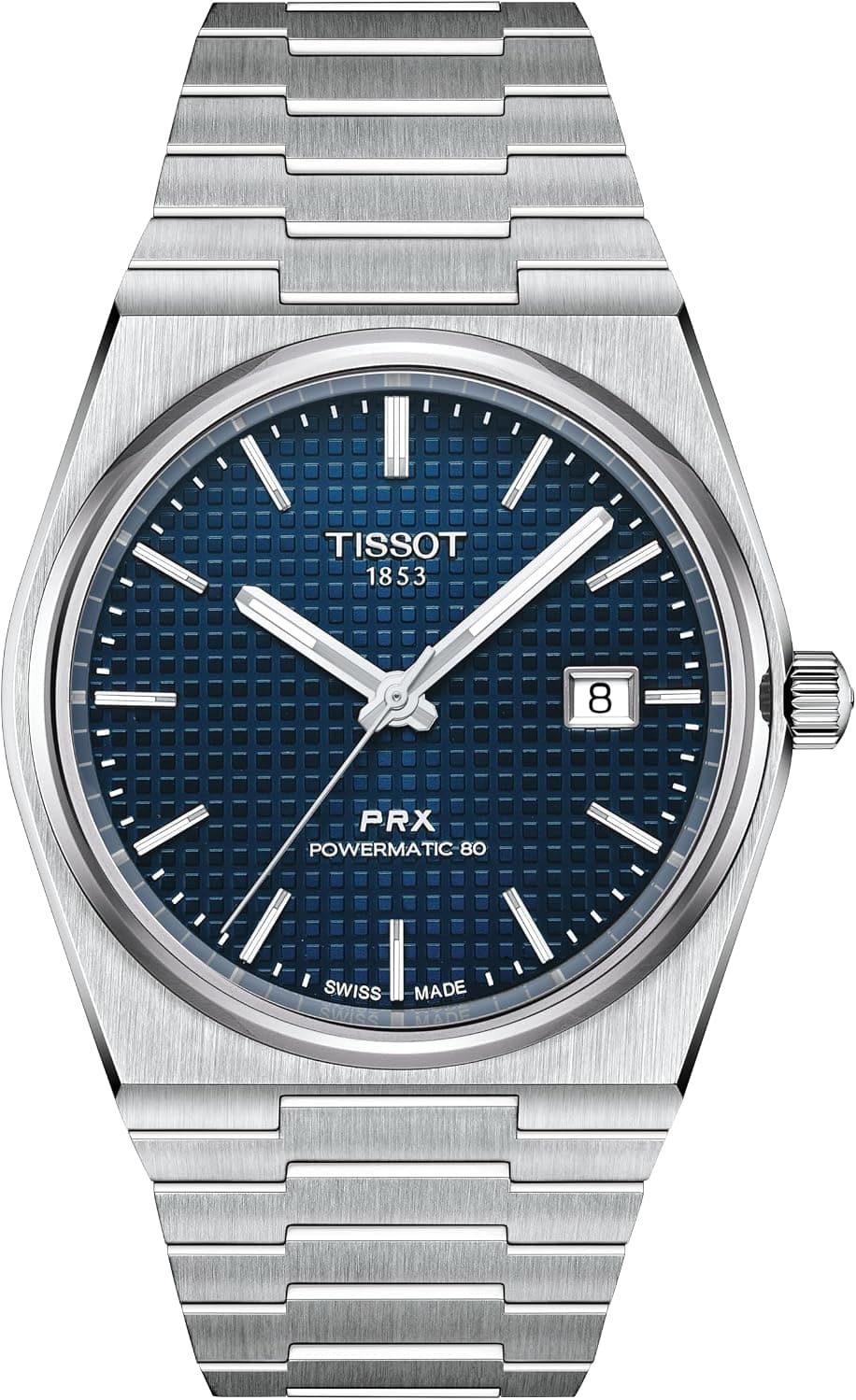
The Tissot PRX Powermatic 80 T137.407.11.041.00 is the automatic version, in the $750 to $1,000 band. Its 40 mm case is 10.93 mm thick and holds Tissot's Swiss automatic Powermatic 80 with 80 hours of power reserve, under sapphire and rated to 100 meters.
The Victorinox I.N.O.X. Automatic 242020 sits in the $1,000 to $1,500 band. Its page spells out the origin in unusual detail: Victorinox says it was engineered and manufactured at its own factory in Delémont, Switzerland, lists Switzerland as the country of origin and names the Sellita SW 200-1 movement.
| Watch | Movement (per maker) | Case (per maker) | Water resistance | US price band |
|---|---|---|---|---|
| Tissot PRX 40 mm quartz | Quartz | 40 mm, 10.40 mm thick | 100 m | $400 to $500 |
| Certina DS-8 Gent 40mm | Quartz | 40 mm, 8.35 mm thick | 100 m | $400 to $500 |
| Hamilton Khaki Field Mechanical 38mm | Hand-wound H-50, 80 hours | 38 mm, 9.5 mm thick | 50 m | $500 to $750 |
| Tissot PRX Powermatic 80 | Automatic Powermatic 80, 80 hours | 40 mm, 10.93 mm thick | 100 m | $750 to $1,000 |
| Victorinox I.N.O.X. Automatic | Automatic Sellita SW 200-1 | 41 mm, 12 mm thick | 200 m | $1,000 to $1,500 |
More picks under $1,000, Swiss and otherwise, are in our best watches under $1,000.
How we looked
The counts come from the Bravery Watch database on November 18, 2026: watches from Tissot, Hamilton, Certina and Victorinox that were in stock on Amazon US with a price updated within the past seven days. We counted by brand and did not check that every listing's dial carries the Swiss Made marking. Price bands are ranges, not prices; our product pages show the current Amazon US price. The movement, case and water resistance figures come from the makers' own pages, read on November 19, 2026. The law is quoted from the English translation on Fedlex, which has no legal force.
Sources
- Swiss Federal Council: Ordinance on the Use of «Switzerland» or «Swiss» for Watches (SR 232.119), status as of January 1, 2019, English translation on Fedlex (checked November 19, 2026)
- Federation of the Swiss Watch Industry FH: Swiss made, the only true benchmark (checked November 19, 2026)
- Federation of the Swiss Watch Industry FH: Stricter Swiss made criteria for watches (checked November 19, 2026)
- Federation of the Swiss Watch Industry FH: Swiss and Swiss made are protected marks (checked November 19, 2026)
- Federation of the Swiss Watch Industry FH: Guide to the use of the designation "Swiss" for watches, version 4, July 12, 2016 (checked November 19, 2026)
- Swiss Federal Institute of Intellectual Property (IPI): Revision of the Ordinance on the Use of "Swiss" for Watches (checked November 19, 2026)
- Tissot: PRX 40 mm product pages, T1374101105100 and T1374071104100 (checked November 19, 2026)
- Certina: DS-8 Gent 40mm product page, C045.410.11.051.00 (archived April 9, 2026; checked November 19, 2026)
- Hamilton: Khaki Field Mechanical 38mm product page, H69439931 (checked November 19, 2026)
- Victorinox: I.N.O.X. Automatic product page, 242020 (checked November 19, 2026)
Watches we recommend
Frequently asked questions
What does Swiss Made mean on a watch?
Swiss Made on a watch means it meets the Swiss ordinance SR 232.119: technical development in Switzerland, a Swiss movement cased in Switzerland, a final inspection by the manufacturer in Switzerland, and at least 60 percent of the manufacturing costs incurred there. It describes origin, not a quality grade.
Is Swiss Movement the same as Swiss Made?
No. Swiss Movement means only that the movement inside the watch meets the Swiss rules for movements; casing, final inspection and most of the cost may have happened elsewhere. Swiss Made covers the whole watch. The Swiss ordinance also requires the word movement to be written in full, in the same lettering as Swiss.
What does Swiss Parts mean on a watch?
Swiss Parts means the movement was made from Swiss movement blanks that were exported, so the parts came from Switzerland and the movement was completed after export. Under the FH guide to the Swiss ordinance, such a movement cannot be called a Swiss movement, and Swiss Parts may not appear on the dial or case.
Are Swiss Made watches better quality?
Not automatically. Swiss Made is an origin label: the Swiss ordinance fixes where development, casing, final inspection and most of the cost happen, but it sets no standard for accuracy, water resistance or materials. Accuracy is certified separately, for example by the COSC chronometer certificate, which Swiss Made does not imply.
Can a quartz watch be Swiss Made?
Yes. A quartz watch can be Swiss Made if it meets the same five conditions as a mechanical one. The Swiss ordinance even allows a quartz movement's electronic modules, display modules and motors to be subassembled abroad. The battery is left out of the 60 percent Swiss share, because the FH guide treats it as a movable component.
Does the strap count toward Swiss Made?
No. The Swiss ordinance says the part that lets you wear the watch is not part of the watch, so the FH's guide leaves the strap or bracelet out of the 60 percent cost share. A Swiss Made watch can come on a strap made anywhere.
How much of a Swiss Made watch has to be made in Switzerland?
At least 60 percent of the manufacturing costs of a Swiss Made watch must be incurred in Switzerland. Its movement needs 60 percent as well, with Swiss parts making up at least half the value of all its parts. Packaging, transport, marketing, the battery and the strap do not count toward the share.
What are affordable Swiss Made watches?
In our data, quartz models were the cheapest way in. On November 18, 2026, the Tissot PRX 40 mm quartz and the Certina DS-8 Gent 40mm were both in the $400 to $500 band in the US. Of 145 in-stock watches from Tissot, Hamilton, Certina and Victorinox, only 23 cost $500 or less.

About the author
Serdar D.Watch Editor
View profileSerdar D. is the editor at BraveryWatch. He believes a good watch should be not just expensive but right. He gets deep into the details, then turns them into something that is genuinely a pleasure to read. He gives relaxed, useful advice through the eyes of someone who truly cares about watches.


