Automatic vs Mechanical vs Quartz: Differences and Price Ranges by Brand on Amazon US
 Serdar D.Watch Editor
Is an automatic watch mechanical? Yes. An automatic is a mechanical watch that winds itself as your wrist moves; a hand-wound one is wound by you at the crown. A quartz watch runs on a battery, or on light if it is solar, and keeps the best time. On Amazon US, a brand's automatics usually cost 1.1 to 2.3 times its quartz watches at the median, not the 11 times you get by pooling every brand, according to the Bravery Watch catalog on October 22, 2026.
Key takeaways
- An automatic is a mechanical watch that winds itself; a hand-wound watch is mechanical too, but you wind it at the crown; a quartz watch runs on a battery or on light and is the most accurate of the three.
- Pooled across all brands, the median automatic we track on Amazon US costs 11 times the median battery quartz watch, because 210 of the 434 automatics come from Rado, Junghans, Hamilton and Longines; within one brand it is usually 1.1 to 2.3 times.
- For a first automatic, start at $200 to $300: 123 of the 434 automatics we track cost $300 or less, 67 of them Orients such as the Orient Mako 3.
What is the difference between automatic, mechanical and quartz watches?
The difference in one line: quartz runs on a battery or on light and keeps the best time, while an automatic is a mechanical watch that your wrist winds.
Here is the short answer from the Bravery Watch catalog. Battery quartz gives you the best timekeeping for the least money, and the Invicta Pro Diver 26971 costs under $100. Never want to change a battery? Go solar, such as the Citizen Corso Eco-Drive. For a mechanism on your wrist, start with an automatic like the Orient Mako 3 at $200 to $300; if you enjoy winding, look at the hand-wound Hamilton Khaki Field Mechanical at $500 to $750 or at an automatic that also winds by hand.
In a quartz watch, a battery makes a quartz crystal vibrate at a steady rate, and that beat keeps the time; solar quartz runs the same way on light. Seiko's Kinetic sits in between: your wrist turns a rotor that charges a cell for a quartz movement. The figures below cover the 2,097 watches in the Bravery Watch catalog that were in stock on Amazon US on October 22, 2026, with a price updated in the past week.
| Battery quartz | Solar quartz | Automatic | Hand-wound | |
|---|---|---|---|---|
| Power | Battery | Light, stored in a cell | Spring wound by your wrist | Spring wound at the crown |
| Battery changes | Every few years | None as routine | None | None |
| Accuracy (maker ratings) | About 15 seconds a month | About 15 seconds a month | A few to tens of seconds a day | A few to tens of seconds a day |
| In our Amazon US catalog, in stock | 1,362 | 165 | 434 | 15 |
| Of those, $300 or less | 1,266 | 98 | 123 | 0 |
Almost every quartz watch we track costs $300 or less; only 123 of the automatics and none of the hand-wound watches do.
Is an automatic watch mechanical?
Yes. A mechanical watch runs on a wound spring instead of a battery, and it comes in two kinds. In an automatic watch, a rotor that swings with your wrist keeps the mainspring wound, so a watch worn every day never needs winding; in a hand-wound watch you wind the spring at the crown, and if you forget, it stops. Many automatics do both: the Orient Mako 3's technical details say "Automatic / Hand-Winding", and Seiko's manual for its 4R36 automatic caliber lists manual winding. Our guide to winding an automatic watch shows how.
How much more does an automatic cost than a quartz watch?
Within the same brand, usually no more than twice as much. Pool every watch we track on Amazon US and the median automatic costs 11 times the median battery quartz watch, but that number measures which brands sell what. Of the 434 automatics, 210 come from Rado, Junghans, Hamilton and Longines, and 184 of those cost more than $1,000. On the quartz side, 745 of the 1,362 watches come from brands with no automatic among the watches we track, such as Guess, Casio and Anne Klein. Leave the four brands out and the gap falls to 3.9 times; compare within each brand and it shrinks again:
| Brand | Automatics | Battery quartz | Automatic vs quartz (median) | Middle half of automatics | Middle half of quartz |
|---|---|---|---|---|---|
| Rado | 93 | 8 | 1.1x | $1,500 and up | $2,000 and up |
| Bulova | 25 | 47 | 1.4x | $300 to $500 | $200 to $500 |
| Longines | 23 | 8 | 1.5x | $1,500 and up | $1,000 to $2,000 |
| Invicta | 21 | 272 | 1.7x | $200 or less | $100 or less |
| Victorinox Swiss Army | 14 | 11 | 1.7x | $1,000 to $1,500 | $500 to $1,000 |
| Stuhrling Original | 8 | 17 | 2.0x | $100 to $300 | $200 or less |
| Hamilton | 47 | 16 | 2.0x | $750 to $1,500 | $300 to $1,000 |
| Citizen | 6 | 22 | 2.3x | $300 to $500 | $100 to $200 |
| Junghans | 47 | 10 | 3.6x | $1,500 and up | $500 to $1,000 |
The ratio compares median prices; the price columns show, rounded out to our price steps, where the middle half of each brand's watches sit.
At Rado there is almost no gap, because its eight quartz models are expensive too, with the middle half at $2,000 and up. At Bulova, quartz is not always the cheaper option: the Bulova Lunar Pilot, a 45 mm quartz chronograph with a sapphire crystal sold as "High Performance Quartz", costs $300 to $500, the same band as the Bulova Surveyor 98B422, a 39 mm steel automatic with a sapphire crystal and 30 meters of water resistance that also winds by hand, according to its listing. Both are in our guide to the best Bulova watches.
Junghans is the outlier because 17 of the 47 Junghans automatics we track are chronographs, mostly Chronoscopes, all over $2,000. Orient is missing from the table because almost all of its watches we track are automatics: 87 of them, five solar models and no battery quartz, with 61 of the automatics at $200 to $300.
How much more is the automatic version of the same watch?
In the two lines we can compare fairly, the automatic costs 1.7 to 2 times the quartz version and the hand-wound one 1.4 to 1.5 times, nowhere near the 11 times of the pooled comparison. Four lines we track on Amazon US come with all three movements; only Hamilton's Khaki Field and Junghans' Max Bill have at least three models of each.
| Watch | Movement | Case | Water resistance (per listing) | Amazon US price band |
|---|---|---|---|---|
| Hamilton Khaki Field Quartz | Battery quartz | 38 mm steel, sapphire | 50 m | $300 to $500 |
| Hamilton Khaki Field Mechanical | Hand-wound | 38 mm, sapphire | 50 m | $500 to $750 |
| Hamilton Khaki Field Automatic | Automatic | 38 mm, sapphire | 100 m | $750 to $1,000 |
| Junghans Max Bill Quartz | Battery quartz | 38 mm, sapphire | 30 m in the title, 50 m in the details | $750 to $1,000 |
| Junghans Max Bill Hand Wind | Hand-wound | 34 mm, sapphire | 30 m | $1,000 to $1,500 |
| Junghans Max Bill Automatic | Automatic | 38 mm, sapphire | 30 m | $1,500 to $2,000 |
Hamilton's Khaki Field line had 9 quartz, 8 hand-wound and 22 automatic models in stock: the automatic costs twice the quartz and the Mechanical one and a half times, though the Khaki Field Automatic above is also rated to 100 meters, the other two to 50. We compare the line with its pilot sibling in Khaki Field vs Khaki Aviation.
Among the Junghans Max Bills without a chronograph, the automatic costs 1.7 times the quartz and the hand-wound model 1.4 times.
How much does a good automatic watch cost on Amazon US?
$300 goes a long way: 123 of the 434 automatics we track on Amazon US cost $300 or less, and 67 of those are Orients. Only 10 cost under $100, 9 of them from Invicta.
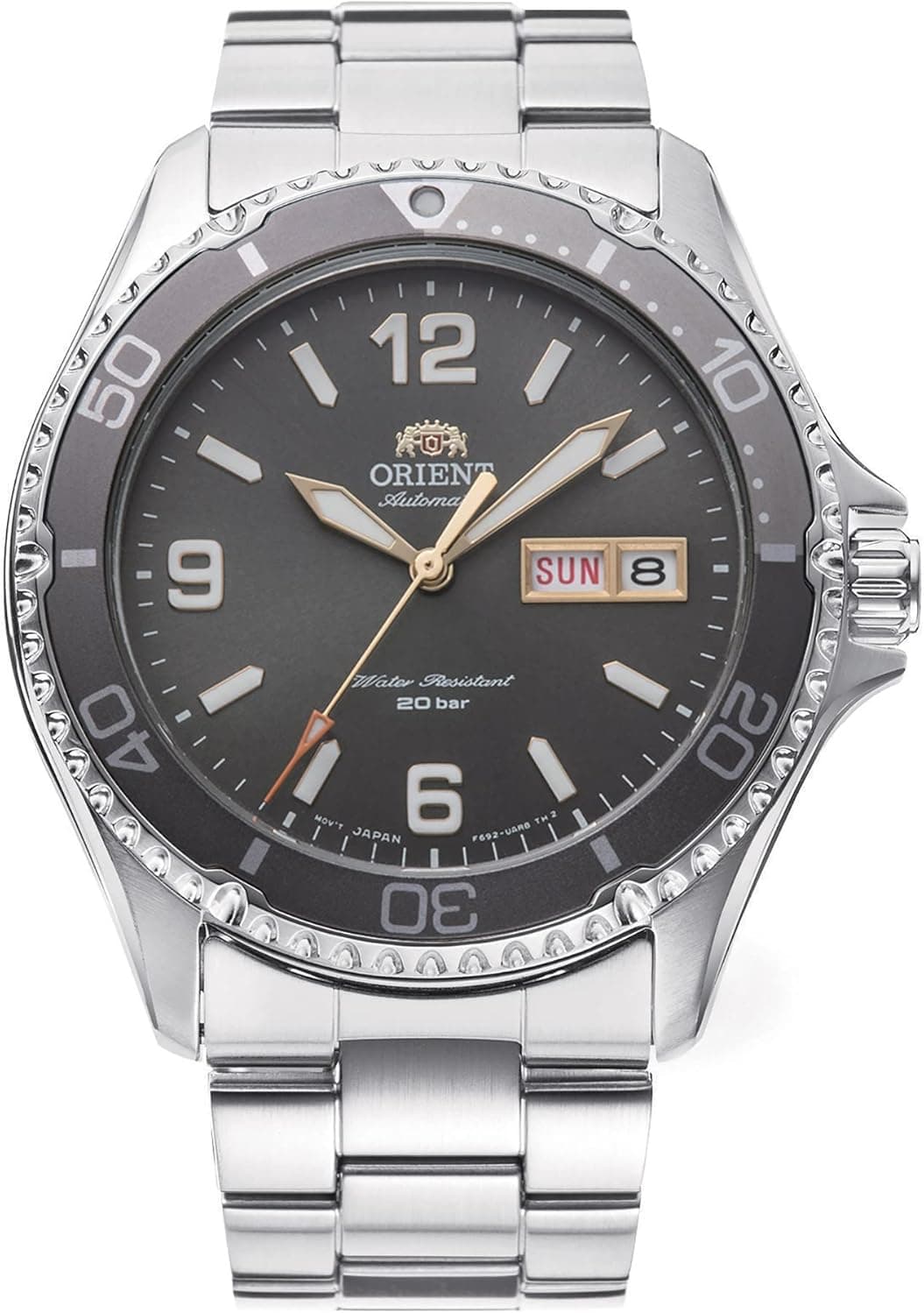
If a friend asked me for a first automatic, I would show them the Orient Mako 3, a dive watch with a 41.8 mm steel case, a sapphire crystal, a screw-down crown and a one-way bezel, listed with 200 meters of water resistance and hand-winding, at $200 to $300; our Orient Mako 3 review has more. For a plain watch to wear with a shirt, the Orient Bambino Version 7 has a 38.4 mm case, a domed mineral crystal, 30 meters of water resistance, and hand-winding and hacking, which stops the seconds hand while you set the time, according to its listing. The Orient Bambino Version 7 also costs $200 to $300; see our Orient Bambino review.
Under $100 there is the Invicta Pro Diver 8928, an automatic with a 40 mm steel case and bracelet, a mineral crystal and 200 meters of water resistance; its quartz counterpart in the line, the Invicta Pro Diver 26971, also has a 40 mm steel case and 200 meters of water resistance and costs under $100 as well. Our Invicta Pro Diver buying guide sorts out the line.
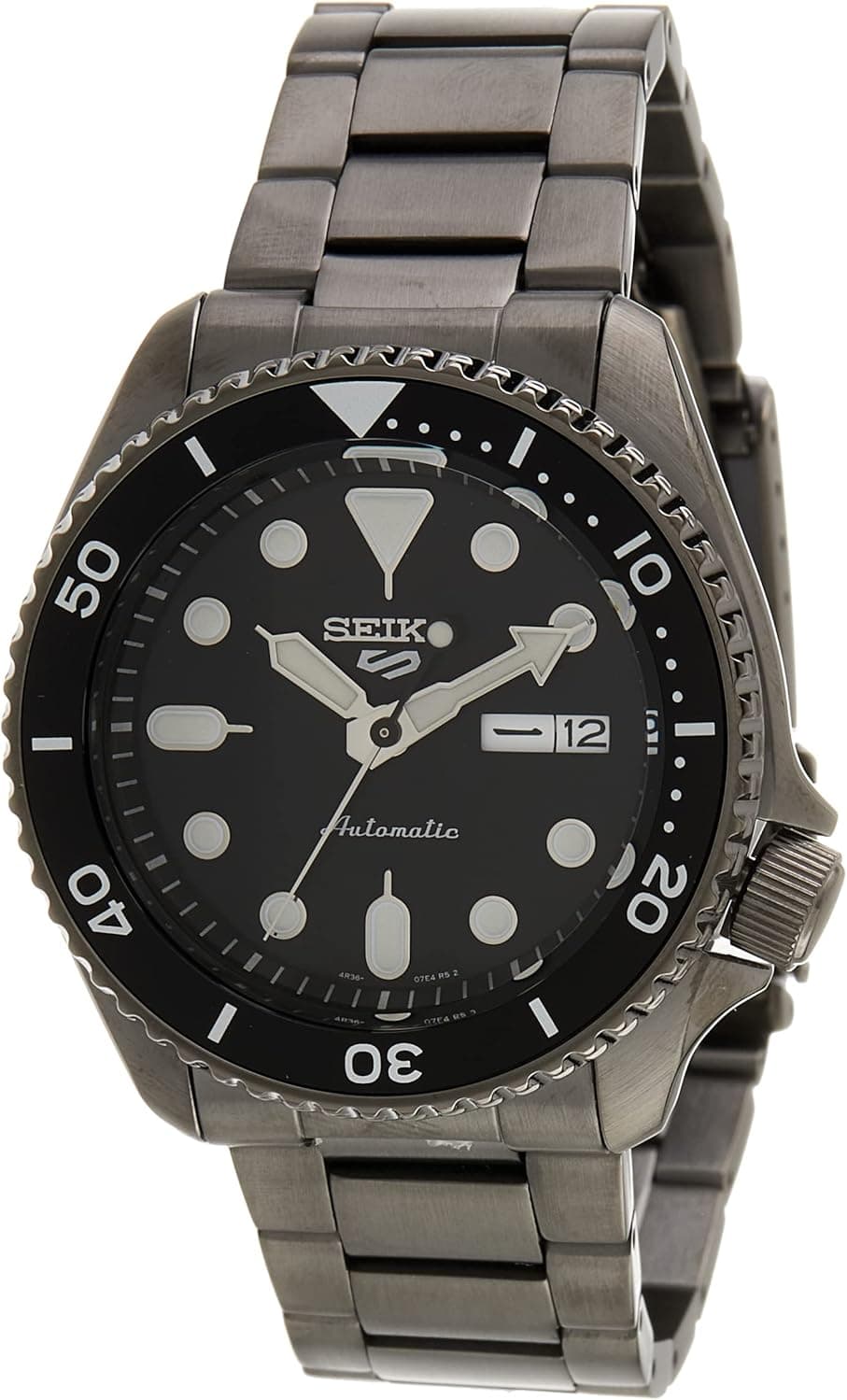
One step up, the Seiko 5 Sports has a 42.5 mm case, a Hardlex crystal, 100 meters of water resistance, a one-way rotating bezel and a day-date display, at $300 to $500. More options are in our guide to automatic watches under $500 and on our automatic watches page.
Solar (Eco-Drive) vs automatic: which is better?
For accuracy and convenience, solar is better; an automatic makes sense if you want a mechanical movement and wear it most days. A solar watch is a quartz watch powered by light, and 139 of the 165 solar watches we track on Amazon US are Citizen Eco-Drive models. Citizen's instruction manual says the solar cell under the dial charges a built-in rechargeable cell that needs no periodic replacement, so a solar watch has a battery you never change; our solar movement entry explains more.
At Citizen, an automatic costs only 1.2 times an Eco-Drive at the median. The Citizen Tsuyosa is an automatic with a 40 mm steel case and bracelet, a sapphire crystal and 50 meters of water resistance, at $300 to $500; the Citizen Corso is an Eco-Drive with a 40 mm steel case and bracelet, a mineral crystal and 100 meters of water resistance, at $200 to $300.
If you won't wear the watch every day, go solar. An automatic stops when its spring runs down: the Orient Bambino Version 7 lists a 40-hour power reserve, so taken off on Friday evening it has stopped by Monday morning. Rotating several automatics? A watch winder keeps them running between wears; one worn every day needs none. Our Eco-Drive picks are in the best Citizen Eco-Drive watches, and more light-powered watches are on our solar quartz page.
Are quartz watches more accurate than automatic watches?
Yes, by a wide margin: Citizen and Seiko rate common quartz movements at about 15 seconds a month, while COSC, the Swiss body that certifies chronometers, allows a mechanical chronometer an average daily deviation of minus 4 to plus 6 seconds. We explain why an automatic watch runs fast or slow in a separate guide.
Upkeep differs too. A battery quartz watch needs a new battery every few years, about three years for Seiko's 8T63, while a mechanical watch needs an occasional service that costs more; see our guides to watch servicing costs and to caring for a mechanical watch.
How do you tell from an Amazon listing whether a watch is automatic or quartz?
Read the title and the technical details together, and in the details check both the movement and the power source line, because they do not always agree. Among the watches we track on Amazon US, six Orients say "Mechanical Hand Wind" in the details while the title or power source says automatic; we count them as automatics. An Invicta titled "Pro Diver Automatic" lists "japanese quartz" and "Battery Powered" in its details, and a Maserati Epoca listed as "automatic" has "Quartz Watch" in its title. If they still disagree, ask the seller before you buy.
Check who sells the watch, too: if it is not Amazon, returns and warranty depend on that seller. Amazon US prices exclude sales tax. And expect an automatic to sit a little higher on the wrist: the median automatic we track is 12.0 mm thick, against 10.0 mm for battery quartz.
Automatic or quartz: which should you buy?
Battery quartz is the default for accuracy and price; start on our quartz watches page. Solar also spares you battery changes. For an automatic, start at $200 to $300, the band that holds 84 of the automatics we track on Amazon US, more than any other below $2,000. True hand-wound watches are scarce in our Amazon US catalog: only 15 were in stock with a current price, 10 of them Hamiltons, and none cost $500 or less. An automatic that also winds by hand, such as the Orient Bambino Version 7, gives you the winding for less.
On the dial, most quartz watches tick once a second, while an automatic's seconds hand glides. And for women the choice is mostly quartz: among the women's watches we track on Amazon US, 578 are battery quartz and only 27 are automatics.
Buying a gift for someone who may not wear it every day? Quartz or solar is safer, because an automatic like the Orient Bambino Version 7 stops within two days in a drawer and has to be reset. More first-watch ideas are in the best watches for beginners.
How we counted
The figures come from the Bravery Watch catalog on October 22, 2026: the 2,097 watches in stock on Amazon US with a price updated in the past seven days, minus 106 smartwatches and 15 watches whose listings don't state the movement clearly. The movement comes from the listing's technical details; where the title or power source line says otherwise we followed them (except for a few basic Casio quartz models marked "Solar Powered"), and where the maker contradicts the listing, as with two Orients and a Junghans Form, we followed the maker. Brand ratios compare median prices for brands with at least five automatics and five battery quartz watches. Accuracy and power reserve figures are published ratings or come from the listings, not our own measurements. Prices exclude sales tax and change daily; our product pages show the current Amazon US price. Our catalog is a selection of watches, not everything sold on Amazon US.
Watches we recommend
Frequently asked questions
Can you wind an automatic watch by hand?
Often, yes. Many automatics also wind at the crown: on Amazon US, the technical details of the Orient Mako 3 and the Bulova Surveyor 98B422 both list hand-winding. If you wear the watch every day, your wrist keeps it wound anyway.
What is the difference between a mechanical and an automatic watch?
Every automatic watch is mechanical, but not every mechanical watch is automatic. "Mechanical" covers all watches driven by a wound spring; an automatic winds itself as you move, while a hand-wound watch is wound by you. Among the watches we track on Amazon US, 434 automatics were in stock and only 15 hand-wound watches.
Is an automatic or a quartz watch better?
It depends on what you value. A quartz watch keeps better time and costs less, and it needs almost no care; an automatic gives you a mechanism that runs without a battery, but it drifts a few to tens of seconds a day and needs an occasional service. Within the same brand, an automatic on Amazon US typically costs 1.1 to 2.3 times the quartz model.
Why are automatic watches more expensive than quartz watches?
Mainly because a mechanical movement takes more work and precision to make, while a quartz movement has fewer moving parts, as the German watch magazine WatchTime explains. Within one brand the gap is smaller than it looks: on Amazon US, a Bulova automatic costs 1.4 times a Bulova quartz watch at the median and a Hamilton automatic 2 times a Hamilton quartz. The 11-times gap across all brands comes from the mix, because Rado, Junghans, Hamilton and Longines make up almost half of the automatics we track, while brands with no automatic in our catalog make up more than half of the quartz watches.
Are quartz watches accurate?
Yes. Citizen and Seiko rate common quartz movements such as the Eco-Drive E365 and the 8T63 at plus or minus 15 seconds a month, about half a second a day. That is tighter than the minus 4 to plus 6 seconds a day that COSC requires of a certified mechanical chronometer.
Is a solar watch better than an automatic?
For accuracy and convenience, yes. A solar watch is a quartz watch charged by light, so it keeps better time and has no routine battery change, while an automatic is mechanical and stops once its power reserve runs out, after about 40 hours on the Orient Bambino Version 7. At Citizen on Amazon US, an automatic costs 1.2 times an Eco-Drive at the median.
Do automatic watches need batteries?
No: an automatic runs on a spring that your wrist winds, and it stops only if you leave it off longer than its power reserve.
How much does a good automatic watch cost?
On Amazon US, $300 is enough: 123 of the 434 automatics we track there cost $300 or less, and 67 of those are Orients. The Orient Mako 3 and the Orient Bambino Version 7 cost $200 to $300, and the Invicta Pro Diver 8928 costs under $100.

About the author
Serdar D.Watch Editor
View profileSerdar D. is the editor at BraveryWatch. He believes a good watch should be not just expensive but right. He gets deep into the details, then turns them into something that is genuinely a pleasure to read. He gives relaxed, useful advice through the eyes of someone who truly cares about watches.