How to Charge a Solar Watch and How Long It Takes
 Serdar D.Watch Editor
To charge a solar watch, put its dial in bright light, ideally direct sun. For the calibers in our table, Citizen, Seiko, Orient and Timex list about 2 minutes of full sun for one day of running, while filling an empty watch takes from 5 hours (Timex) to 40 hours (Citizen's year-long calibers). Check the row for your caliber.
Key takeaways
- Office light is slow: one day of running takes 1.8 hours on a Seiko V158 at 700 lux and 8 hours on Casio's module 3495 at 500 lux, and neither table gives a full charge at that level.
- Citizen wants incandescent and halogen bulbs at least 20 inches from a charging watch and no charging at about 140°F or more; Junghans stops at 122°F, and Casio warns against charging for long periods in direct sun.
- A second hand jumping in two-second steps means the watch needs light. Most of Citizen's E-series calibers stop about 4 days later, Orient's VS42 within about a day.
How do you charge a solar watch?
You charge a solar watch by putting its dial in bright light and leaving it there; there is no cable, and direct sunlight works fastest. A day of running comes quickly: for the calibers in the table below, Citizen, Seiko, Orient and Timex list about 2 minutes of full sun. Filling an empty watch takes far longer and depends on the caliber inside, from 5 hours of that sun for Timex's solar analogs to 40 hours for Citizen's year-long Eco-Drive calibers.
The solar cell sits under the dial, so the dial needs the light; Seiko names a sleeve over it as the most likely reason a watch worn every day still runs down. Off the wrist, Citizen suggests a windowsill where it can catch direct sun. How the rechargeable cell works, and how long it lasts, is in our solar movement entry.
No single rule of thumb covers this: each maker publishes its own tables in lux, and they differ from caliber to caliber. Bravery Watch tracks solar watches from Citizen to Junghans in the US, UK and German markets, so I set those tables side by side.
How long does it take to charge a solar watch?
Minutes for a day of running, hours for a full charge, and the caliber decides how many hours. The makers rate light in lux: Citizen and Seiko set full sun at 100,000 lux, a cloudy day outdoors at 10,000 lux and the spot 8 inches (20 cm) under a 30-watt fluorescent tube at 3,000 lux, with office lighting at 500 to 700 lux. Casio and Junghans rate a sunny day at 50,000 lux, so their rows don't line up minute for minute with the others.
| Watch and caliber | Light | One day of running | Full charge from empty | Runs on a full charge | Source |
|---|---|---|---|---|---|
| Citizen Eco-Drive, basic analog | 100,000 lux | 2 minutes | 11 hours | 6 months or more | Citizen US support |
| Citizen E111, E168 | 100,000 lux | 2 minutes | 12 hours | about 6 months | Citizen manual |
| Citizen E005, E015, E035, E105, E115 and related | 100,000 lux | 2 minutes | 40 hours | about 1 year | Citizen manual |
| Citizen B612 chronograph | 100,000 lux | 2 minutes | 8.5 hours | about 7 months | Citizen manual |
| Citizen B620 chronograph | 100,000 lux | 2 minutes | 9 hours | about 9 months | Citizen manual |
| Seiko V147, V157, V158 | 100,000 lux | 2 minutes | 9 hours | about 10 months | Seiko instructions |
| Orient VS42 | 100,000 lux | about 2 minutes | about 9 hours | about 12 months | Orient guide |
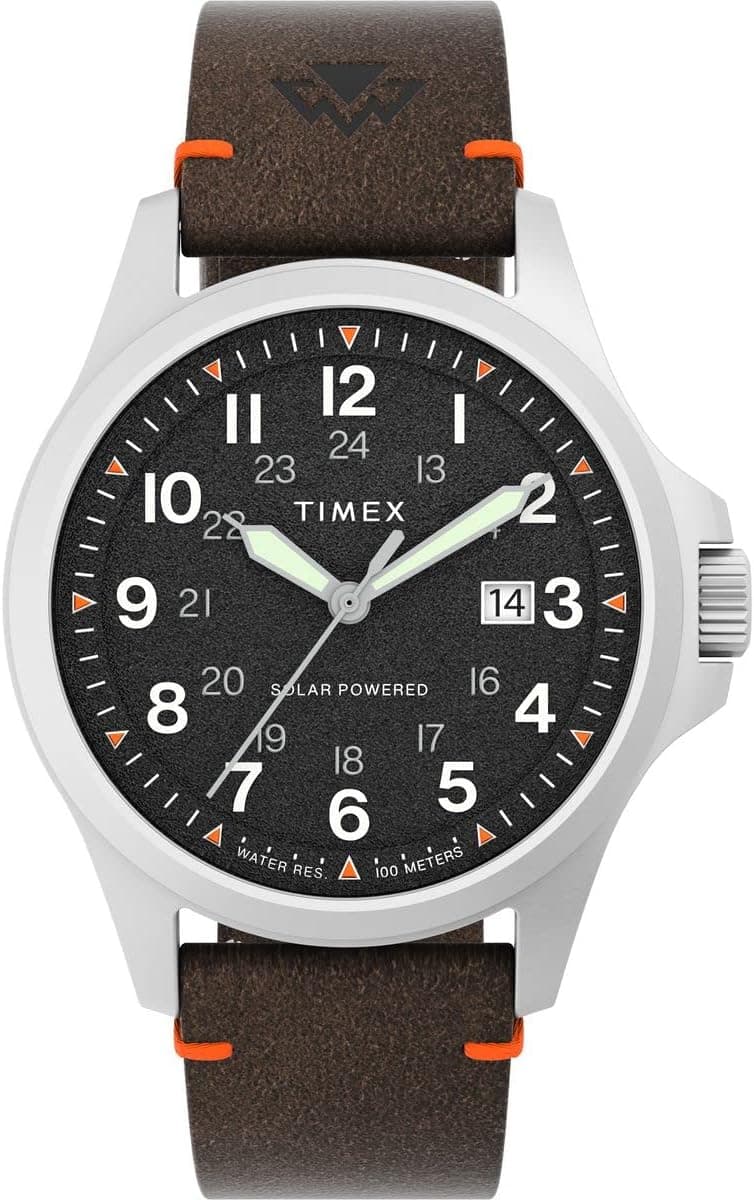
| Timex Expedition Gallatin Solar | 100,000 lux | 2 minutes | 5 hours | 4 months | Timex |
| Ronda 215 (Victorinox Concept One Solar) | sunny, outdoors | 3 minutes | 10 hours | about 8 months | Ronda |
| Casio module 3495 (G-SHOCK) | 50,000 lux | 8 minutes | about 47 hours | about 10 months | Casio |
| Junghans J615.84 | 50,000 lux | about 7 minutes | about 24 hours | up to 21 months | Junghans |
| Junghans J101.85 (max bill MEGA Solar) | 50,000 lux | at least 2 minutes | at least 7 hours | up to 3 months | Junghans |
All times assume continuous light on the dial. A day of running is cheap on every caliber; the full charge sets them apart, even within one maker. Citizen's E111 and E168 fill in 12 hours and run about 6 months, while the E115 family needs 40 hours and then runs about a year, and the two Junghans movements split the same way.
A few cells need explaining. The 24 hours in the Junghans row mean continuous light, more than one sunny day supplies, and Casio's 47 hours add up three stages, 34 of them for the middle step from a medium to a high charge, so a sunny afternoon only starts the climb. Two makers also give two reserves: Orient's VS42 guide says about 12 months and its US pages for the Mako 40 about 6, and Timex's Gallatin Solar pages promise 4 months, its general booklet up to 2.
To find your row, look at the back: Citizen's manual says the first four characters of the case number are the caliber, Casio stamps the module number there, and our guide to finding your watch's model number covers the other brands.
How do you charge a Citizen Eco-Drive?
The same way: dial to the light. What changes from one Eco-Drive to the next is how long it takes, and Citizen publishes a table for each caliber.
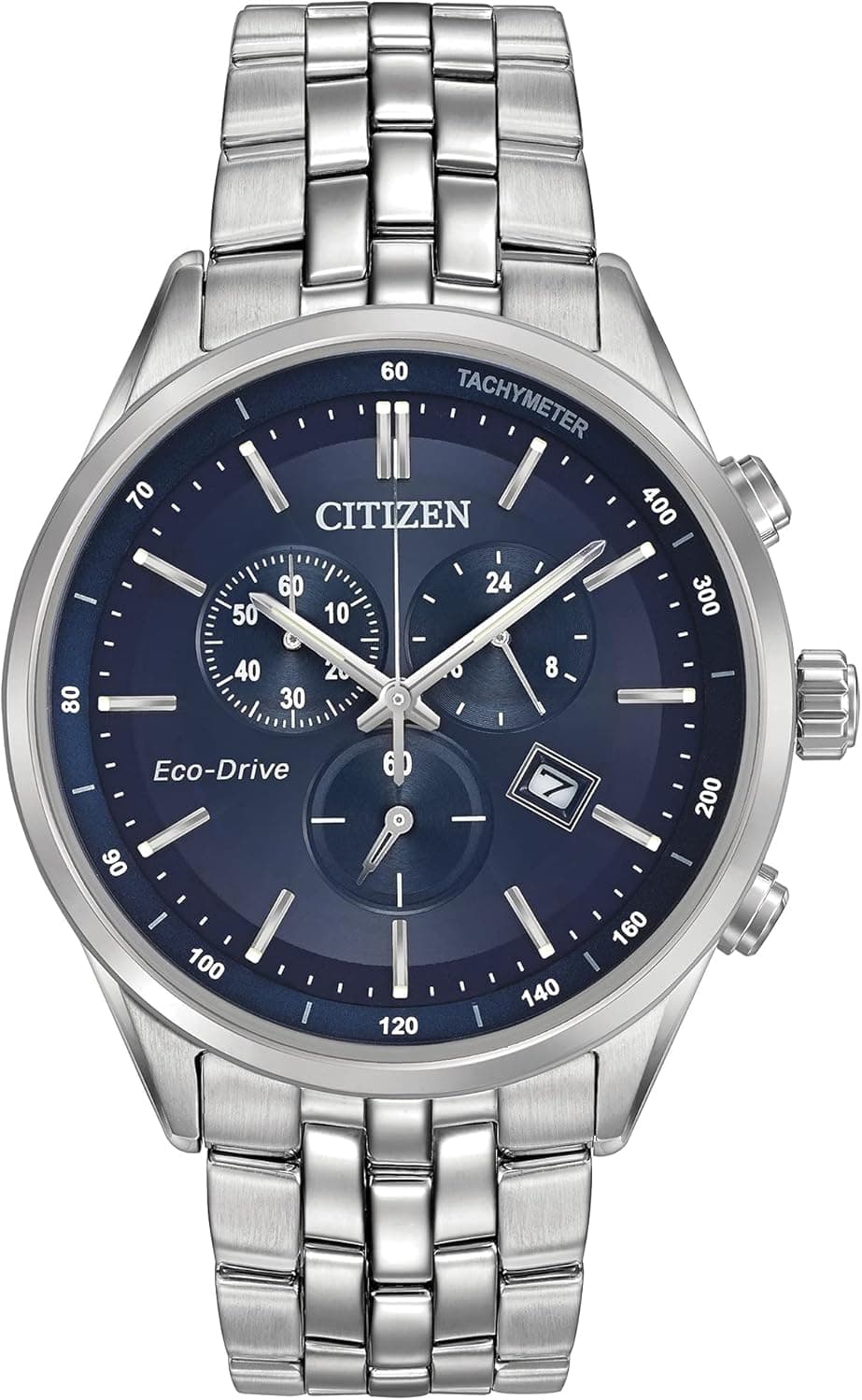
Of the 137 Eco-Drives in our US count, 32 use a caliber from the year-long family, the 40-hour row; I matched their model numbers against Citizen's own manual index. The Citizen Chandler BM6838-17L runs on the E111, and the Citizen Brycen CA0780-52E chronograph on the B612. The J810, the most common caliber in that count, has no row: its short sheet refers to a general manual I could not find.
Citizen's routine advice for an Eco-Drive is 5 or 6 hours of direct sun at least once a month. For a watch you won't wear for a while, the E-series manual says to keep the dial in the light and pull the crown out to stop the hands and save power, and Citizen's support page caps storage in the dark at 6 months. Our Citizen Eco-Drive guide covers the models.
Can you charge a solar watch with a lamp or without sun?
Yes, any light charges it, but indoor light is slow, and Citizen's E-series manual says plainly that a fluorescent lamp or interior lighting does not charge the cell efficiently. Under office light a Seiko V158 needs 1.8 hours for one day of running at 700 lux, a Citizen E111 needs 4 hours at 500 lux and Casio's module 3495 twice that, and none of those three tables gives a full charge at that level. For a stopped watch, I'd skip the desk and go straight to the sun.
Without sun, daylight still beats a lamp. Citizen rates a cloudy day outdoors at 10,000 lux, which gives a basic analog Eco-Drive a day of running in 12 minutes; under a 30-watt fluorescent tube 8 inches away, the same watch needs 40 minutes, and a full charge takes 130 hours. A window on a gray day gives less than the open sky: Casio puts it at 5,000 lux, or 48 minutes for a day on its module 3495. None of the manuals I read rates LED bulbs; they measure light in lux, whatever the source.
Heat is the catch, from bulbs and from the sun alike. Citizen wants incandescent and halogen lamps at least 20 inches away and no charging at about 140°F (60°C) or more; Seiko sets the same limit and warns against spotlights, and Junghans stops at 122°F (50°C), where Orient's VS42 operating range also ends. In the sun, Casio warns against charging for long periods in direct sunlight or other hot places, and Ronda, which makes the Concept One's movement, names behind glass as a spot that can pass 140°F. A sunny dashboard is out, say Citizen, Seiko and Casio, so Citizen's windowsill works only while the watch stays below those limits.
Why did my Citizen Eco-Drive stop working?
Usually because it ran out of light. On most calibers the second hand first jumps in two-second steps, which Citizen's support page calls a sign the watch needs recharging; Seiko and Orient use the same warning. How long you have then depends on the caliber: about 4 days on most of Citizen's E-series calibers, 7 on the B612 and 8 on the B620, but only about a day on Orient's VS42.
To bring a stopped one back:
- Put the dial in direct sun. On some Citizen models the second hand soon moves in two-second steps, though Citizen warns that indoor light may not keep it going.
- Keep charging until the second hand moves every second. Some Citizen models move it three times every four seconds instead, Citizen's sign that the watch restarted on the wrong time: charge it well, then set it.
- Don't stop at the first ticks. Seiko notes that a short charge can slip back to two-second steps, and for an E111 Citizen gives 18 minutes of sun to run normally but 12 hours for a full charge.
Why is my solar watch not charging?
Sometimes it is, and something simpler is wrong. Citizen's troubleshooting table says a second hand that doesn't move may just need the crown pushed in. A Casio on module 3495 with a blank display after a night in a drawer may be power saving, not dead: it blanks after about an hour in the dark between 10 p.m. and 6 a.m., and a button press or bright light wakes it.
If a stopped watch still won't run normally after more than the full-charge time in its table, Seiko's answer is that the light was too weak and the watch needs more time. Past that, Seiko says the cell's capacity can drop with long use and asks for a repair, and Citizen sends you to an authorized service center.
Never put an ordinary silver-oxide battery in place of the rechargeable cell, Citizen says: it can overcharge and burst, and Seiko warns it can overheat. Our guide to whether watches need batteries covers the watches that do take a replaceable one.
Which charging table fits your solar watch?
On November 12, 2026, Bravery Watch counted 163 solar watches in stock on Amazon US with a price updated within the past week. Citizen made 137 of them, so a Citizen table covers most of them; the rest came from Junghans (8), Timex (6), Orient (5), Casio and Victorinox (2 each), and Anne Klein, Bering and Seiko (1 each). Amazon UK had far fewer: 18 solar watches, 5 of them Citizen and 5 Timex.
For the other brands, the Junghans Force Mega Solar runs on the J615.84 and the Junghans max bill MEGA Solar on the J101.85, and Seiko gives the V158 for its Essentials solar models SNE525 and SNE529, which covers our Seiko Essentials. Casio gives module 3495 for the Casio G-SHOCK GW-M5610U, Orient's VS42 guide covers the Orient Mako 40 RA-WJ0004Y10B, Victorinox puts Ronda's 215 in the Concept One Solar, and the Timex Expedition Gallatin Solar TW2U30300 is the Timex row itself.
Bering's instructions give about 6 hours of blue-sky sun for a full charge; for the Anne Klein I found no figure from its maker. More models are on our solar quartz page.
How we looked
The counts come from the Bravery Watch database on November 12, 2026: the 163 solar watches in stock on Amazon US and the 18 on Amazon UK, each with a price updated within the past seven days. A watch counted as solar when its listing title said Solar or Eco-Drive. If only the spec sheet's power source or movement line said solar, it counted only with the maker's own confirmation, which added 8 of the 163 and left out 12 other US listings, among them basic Casio analogs listed as solar and a Casio AQ-S820W whose maker page I could not open. Fields our system fills in automatically never counted, and 6 Garmin and Amazfit smartwatches with Solar in their names are left out. The charging figures are the makers' own for continuous light; real charging also depends on the dial and the weather.
Sources
- Citizen Watch America: How do I charge my eco-drive watch? (support article, last edited May 22, 2024; checked November 12, 2026)
- Citizen Watch America: The second hand on my eco-drive watch "jumps" instead of ticking every second (support article; checked November 12, 2026)
- Citizen Watch Co.: Instruction manual for calibers B023/B035/B036/B690, E0xx/E1xx and J015/J165 (Eco-Drive), charging tables on pages 9 to 16 (checked November 12, 2026)
- Citizen Watch Co.: Instruction manual for caliber B612 (checked November 12, 2026)
- Citizen Watch Co.: Instruction manual for caliber B620 (checked November 12, 2026)
- Citizen Watch Co.: model and caliber index behind its online instruction manual search (checked November 12, 2026)
- Seiko Watch Corporation: Instructions for calibers V131, V145, V147, V157 and V158 (Guide to charging times, About energy, Power Source, Troubleshooting, Specifications; checked November 12, 2026)
- Seiko Watch Corporation: SNE525 and SNE529 product pages, specifications (checked November 12, 2026)
- Orient: User's Guide, caliber VS42 (WJ), Specifications, Charging and Checking the Energy Level (checked November 12, 2026)
- Orient Watch USA: RA-WJ0004Y10B and RA-WJ0001E10B product pages (archived May 19 and April 14, 2026; checked November 12, 2026)
- Orient Watches UK: Orient Mako Chronograph Solar RN-TX0204E product page (checked November 12, 2026)
- Timex: analog watch instructions, booklet 06R-395000-01, Solar Movement (checked November 12, 2026)
- Timex: Expedition Gallatin Solar 44mm product pages, TW2U30300 and TW4B14500 (checked November 12, 2026)
- Timex: Expedition Freedive Ocean 46mm product page, TW2V40300 (archived May 25, 2025; checked November 12, 2026)
- Ronda: User's Manual for the RONDA solartech calibers 212 to 215, June 2025 (checked November 12, 2026)
- Victorinox: Concept One press page (checked November 12, 2026)
- Casio Computer Co.: Operation Guide, Module No. 3495 (Charging; Specifications; checked November 12, 2026)
- Casio Computer Co.: Operation Guide, Module No. 5459/5460, About This Manual (checked November 12, 2026)
- Casio Europe: GW-M5610U-1 product page (archived April 11, 2025; checked November 12, 2026)
- Casio America: MTP-S110-1AV product page (archived December 12, 2024; checked November 12, 2026)
- Uhrenfabrik Junghans: manual for the J615.84 multi-frequency radio-controlled solar movement (Force Mega Solar, Spektrum Mega Solar), charging times (checked November 12, 2026)
- Uhrenfabrik Junghans: manual for the MEGA Solar J101.85 (max bill MEGA Solar), solar technology and charging times (checked November 12, 2026)
- Bering: Solar instructions (checked November 12, 2026)
Watches we recommend
Frequently asked questions
How long does it take to charge a solar watch?
A solar watch's charging time depends on its caliber. On most Citizen, Seiko, Orient and Timex calibers, about 2 minutes of full sun at 100,000 lux buys a day of running, while filling an empty watch takes 5 hours on a Timex Expedition Gallatin Solar, 9 on a Seiko V158 and 40 on Citizen's year-long Eco-Drives.
How do I charge my Citizen Eco-Drive?
Put the Eco-Drive's dial in bright light, ideally direct sun, and keep your sleeve off it. Citizen's US support page gives a basic analog model 2 minutes of full sun for a day of running and 11 hours for a full charge, and its manuals ask for 5 or 6 hours of direct sun once a month.
Why did my Citizen Eco-Drive stop working?
An Eco-Drive usually stops for lack of light. Its second hand first jumps in two-second steps, and most of Citizen's E-series calibers stop about 4 days later. Put the dial in direct sun, let it charge well and set the time. If that fails, Citizen sends you to an authorized service center.
Can you charge a solar watch with a lamp?
Yes, but a lamp charges a solar watch slowly, and hot bulbs need distance. Eight inches under a 30-watt fluorescent tube, a basic analog Eco-Drive needs 40 minutes for a day of running and 130 hours for a full charge, Citizen says. It wants incandescent and halogen lamps at least 20 inches away.
Does a solar watch need direct sunlight?
No. Any light charges a solar watch, but direct sun is by far the fastest. Office light of 500 to 700 lux gives a day of running in 1.8 hours on a Seiko V158 and in 8 hours on Casio's module 3495, and neither table lists a full charge at that level.
How do you charge a solar watch without sun?
A solar watch still charges in daylight without direct sun. Citizen rates a cloudy day outdoors at 10,000 lux, enough for a day of running on a basic analog Eco-Drive in 12 minutes. Indoors, use the brightest window or a fluorescent lamp about 8 inches away, and keep incandescent or halogen bulbs at least 20 inches from the watch.
Why is my solar watch not charging?
A solar watch that seems dead may just be charging slowly or asleep. A Casio on module 3495 blanks its display after about an hour in the dark at night, and a button press wakes it. On a Citizen with a frozen second hand, push the crown in.
How long does an Eco-Drive take to charge?
On most Eco-Drive calibers, a day of running takes about 2 minutes of full sun. From empty, Citizen's manuals give 8.5 hours for the B612 chronograph, 9 for the B620, 12 for the E111 and E168 and 40 for the year-long E115 family.

About the author
Serdar D.Watch Editor
View profileSerdar D. is the editor at BraveryWatch. He believes a good watch should be not just expensive but right. He gets deep into the details, then turns them into something that is genuinely a pleasure to read. He gives relaxed, useful advice through the eyes of someone who truly cares about watches.